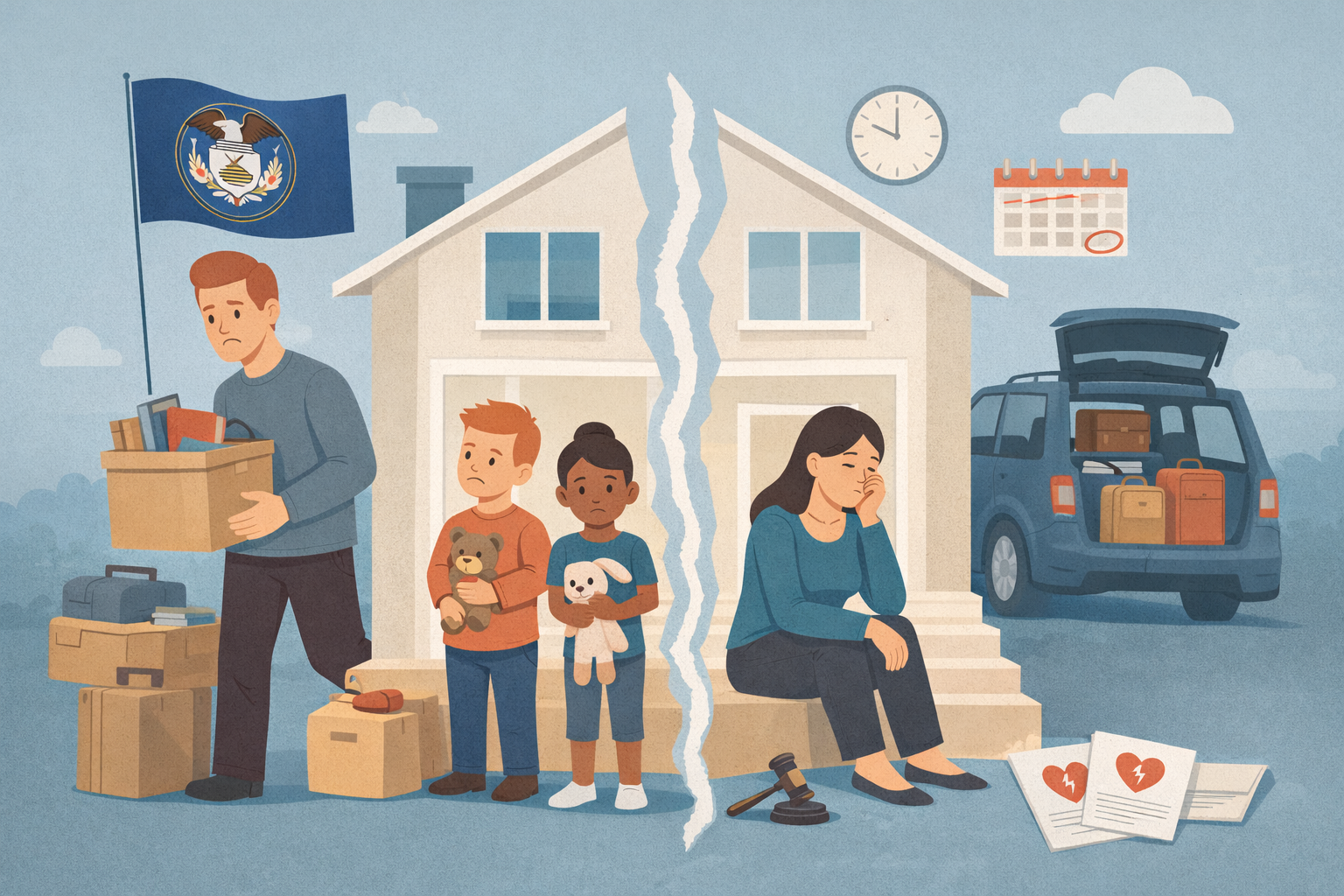
Before You Move Out: 10 Things to Check in a Utah Divorce
Last reviewed: July 16, 2026
Thinking about leaving the house tonight or sometime this week? The honest answer is that moving out can be the safest or most practical choice. It can also create avoidable problems with the children, the mortgage, utilities, insurance, property access, court papers, or the temporary schedule that takes shape while the divorce is pending.
The useful question is not only, “Can I move out?” It is, “What changes the moment I do?” I’m Dustin Gibb. When someone sits down with me in Kaysville and asks that question, I start with safety. Then I check the children, the home, the money, the records, and whether a court order is needed. Here are the ten things I would walk through before you pack a bag—unless waiting would put you or a child in danger.
The Five-Minute Answer Before You Move
Moving out does not settle the divorce. It does not, by itself, decide who receives the home, where the children will live, or who must pay each bill. Those issues may be handled by agreement, by temporary orders while the case is pending, and eventually by the final decree.
If you or a child is in immediate danger: Get to a safe place and call 911. Do not stay in an unsafe home because you are worried that leaving will “look bad” in court.
If children are involved: Think through where they will sleep, how school and childcare will work, and what the next two weeks of parent-time will look like before making a sudden change.
If the case has been filed: Read the domestic relations injunction. Utah’s automatic injunction places limits on property transfers, insurance changes, utility interference, harassment, and certain conduct involving children.
If you cannot agree on the home, children, support, or bills: Consider whether temporary orders in a Utah divorce are needed before or soon after the move.
If you have not filed yet: Review the first steps in filing for divorce in Utah, including service, the injunction, financial disclosures, and temporary-order planning.
The first video addresses the question most people ask at the beginning: whether moving out affects their rights to the home and the divorce process.
Watch: Can I Move Out of the House During a Utah Divorce?
Before You Move Out: The 10-Point Utah Divorce Checklist
You do not need a perfect plan before you leave. You do need to know which problems cannot safely wait. Work through these checks in order, then adjust them to your family and the court orders already in place.
Check safety first
If you are afraid of violence, threats, stalking, forced confinement, or retaliation, treat this as a safety decision before treating it as a property decision. In immediate danger, call 911. A Utah protective order may be able to restrict contact, require someone to stay away, and temporarily address the home or children. A domestic relations injunction is not a substitute for a safety order.
Write down the children’s next 14 days
Start with the real schedule: school mornings, daycare, medications, activities, bedtimes, transportation, and exchanges. A move that sounds manageable in the abstract can fall apart on Tuesday morning. Put a proposed short-term schedule in writing and keep the children out of the negotiation. For more detail, review parenting plans and custody schedules in Utah.
Decide whether temporary orders are needed
Temporary orders can set enforceable rules for custody, parent-time, child support, temporary alimony, use of the home, vehicles, bill payment, and debts while the divorce is pending. They are not required in every case. They become important when an informal agreement is missing, unclear, unsafe, or likely to collapse.
Read the domestic relations injunction if a case has been filed
Utah courts enter a domestic relations injunction when the initial divorce petition is filed. It binds the filing spouse at filing and the other spouse after receiving it. Among other things, it restricts hiding or transferring property, interfering with phone or utility service, changing covered insurance without consent or court permission, harassment, and involving children in the dispute. It preserves the situation; it does not decide who gets the home or the temporary custody schedule.
Build a two-household budget before signing a lease
List the mortgage or rent, a new deposit, utilities, insurance, food, transportation, childcare, debt payments, and the cost of exchanges between homes. Moving out does not make the old bills disappear. If support, housing costs, or bill responsibility may be disputed, organize the numbers for a Utah financial declaration for temporary orders.
Protect access without creating a property fight
Photograph the condition of the home and make a simple inventory of important property. Take essential personal items, medication, work equipment, and children’s necessities as safety and existing orders allow. Do not empty accounts, hide property, sell disputed items, shut off services, or turn the move into a race to control everything. If access to the home will be disputed, temporary orders may be the cleaner answer.
Copy the documents you will need
Gather lawful copies of tax returns, pay records, bank and retirement statements, credit-card and loan records, deeds, mortgage or lease documents, insurance policies, vehicle information, business records, school and medical information, and current court papers. Store them somewhere secure. Do not use passwords or accounts you are not authorized to access.
Plan for mail, court notices, address changes, and service
Forwarding your mail does not automatically update the court or the other party. Check the rules for updating your address, service, and protected contact information. If safety is a concern, ask about options before disclosing a new location. If you have already been served, moving does not pause your response deadline or hearing date.
Choose one calm communication channel
Use one written channel for schedules, bills, access, and child-related information. Keep messages short, factual, and boring. Do not use the children to carry messages or negotiate parent-time. If a protective order or no-contact provision exists, follow it exactly rather than relying on an informal exception.
Check the distance before you change the family’s routine
A move across Davis County can change school transportation and weekday exchanges. A longer move can create additional custody and relocation issues, especially when an existing order already governs parent-time. Before signing a distant lease or moving the children, map the school route, exchanges, work schedules, travel costs, and the actual time each parent can exercise. Then review the existing order and Utah’s relocation rules.
You generally do not have to leave the marital home simply because a divorce is beginning. The better choice depends on safety, the children, the money, the existing orders, and whether the court needs to set temporary rules.
The relocation video below is useful when a proposed move would change school, travel time, or the practical parent-time schedule.
Watch: Relocation and Moving With Children During or After Divorce
If distance is part of the problem, read Gibb Law’s guide to relocation after divorce in Utah. A pending divorce and an existing final order are not always handled the same way, so start with the order and facts you actually have.
Which Utah Court Tool Fits the Problem?
These tools overlap, but they do different jobs. Confusing them can leave the most important issue unresolved.
Domestic relations injunction
Enters when the initial petition is filed. It limits conduct involving property, insurance, utilities, harassment, and children. It does not award the home or create a complete custody schedule.
Temporary orders
Set short-term, enforceable rules while the case is pending. They can address custody, parent-time, support, use of the home, vehicles, expenses, and debt payment.
Protective order
Addresses abuse, threats, fear of harm, and safety. Depending on the order, it may restrict contact or access and temporarily address the home, custody, or parent-time.
Written stipulation
If both spouses agree, a written stipulation can ask the court to enter clear temporary terms. A casual text exchange may document a conversation, but it may not provide the same clarity or enforceability as a court order.
A Practical Checklist for Tonight or This Week
Use this as a decision list, not permission to make unilateral changes. Existing court orders, safety concerns, and the facts of your case come first.
| Decision area | Check before you move | Avoid doing this impulsively |
|---|---|---|
| Children | Write a workable two-week schedule for school, childcare, overnights, medication, activities, and exchanges. | Do not make the children carry messages or announce a major schedule change through them. |
| Money | List both households’ immediate expenses and decide what must be paid before the next paycheck. | Do not empty accounts, stop all payments, or assume the other spouse will cover the old household. |
| Home access | Photograph the home, inventory major items, and identify what you will need for work, health, and the children. | Do not change locks, remove disputed property, or create a confrontation over possessions without checking the orders and safety plan. |
| Documents | Secure lawful copies of financial, property, insurance, school, medical, business, and court records. | Do not access an account or device you are not authorized to use. |
| Insurance and utilities | Confirm what is active, what is due, and what the domestic relations injunction allows. | Do not cancel coverage, change beneficiaries, or cut off services when the injunction or another order prohibits it. |
| Safety | Choose a safe location, transportation plan, emergency contact, medication plan, and secure way to communicate. | Do not disclose a safe address or planned departure when doing so would increase the risk. |
| Address and mail | Plan mail forwarding and check how to update the court while protecting confidential contact information where appropriate. | Do not assume postal forwarding updates the court, counsel, or the other party. |
| Service and deadlines | Keep copies of the petition, summons, injunction, motions, notices, proof of service, and hearing dates. | Do not let a move cause you to miss a response deadline, class requirement, filing, or hearing. |
| Temporary orders | Identify what must be decided now: home use, custody, parent-time, support, vehicles, bills, or debts. | Do not rely on a vague verbal promise when the family needs an enforceable short-term rule. |
| Communication | Choose one written channel and keep messages factual, child-focused, and limited to necessary logistics. | Do not send threats, insults, long emotional histories, or messages that violate a no-contact rule. |
Documents to Gather Before Access Gets Harder
A move often turns one shared filing cabinet into two separate households. Gather what you can lawfully access before the records become difficult to find. Utah divorce cases generally require a financial declaration and supporting information, and temporary money requests may require that paperwork earlier in the case.
Income: Recent pay stubs, year-to-date income, bonus or commission records, self-employment information, and proof of other income.
Taxes and accounts: Recent tax returns, bank statements, retirement statements, investment records, credit-card statements, and current debt balances.
Housing and insurance: Deed, mortgage, refinance records, lease, utility statements, homeowner’s or renter’s insurance, auto coverage, health insurance, and life insurance information.
Children: School calendar, childcare costs, health coverage, medical needs, activity schedules, transportation needs, and the current overnight pattern.
Court and communication records: Petition, summons, domestic relations injunction, temporary-order papers, existing custody orders, notices, and a focused timeline of important messages or incidents.
For a more complete document list, use the guide to preparing a Utah financial declaration for temporary orders. The numbers should match the housing, support, and bill-payment terms you are asking the court to consider.
This video covers a small step that causes large problems when it is missed: keeping the court’s contact information current after a move.
Watch: Why Updating Your Address With the Court Matters
Common Mistakes After One Spouse Moves Out
The move itself is rarely the whole problem. The harder issues usually come from what happens in the first few days afterward.
Disappearing from the children’s daily life: Keep showing up for school, medical needs, activities, calls, and the parent-time you can safely exercise. A temporary arrangement can quickly become the routine everyone points to.
Stopping mortgage, rent, insurance, or utilities without a plan: A second residence creates pressure, but missed payments can create a new problem for both spouses and may violate an injunction or order.
Taking money or property to “get ahead”: Document the property and ask for clear temporary terms. Do not create a concealment or credibility issue while trying to protect yourself.
Letting every text become an argument: One useful message about Friday pickup is better than twelve paragraphs about the marriage. Write for the practical reader who may later see the message.
Signing a distant lease before checking the parenting schedule: The address may look affordable until school transportation, work commutes, exchanges, and travel costs are added.
Assuming moving out gives up the home—or guarantees it to the spouse who stays: The court still has to address property, debt, temporary possession, and the final division. Keep records instead of relying on that assumption.
Missing service, filings, classes, or hearings: A change of address does not stop the case. Keep one calendar for court dates, response deadlines, parenting classes, mediation, and financial disclosures.
This reel highlights practical risks that can appear after one spouse leaves, especially when the children’s routines begin changing before temporary orders are in place.
Frequently Asked Questions About Moving Out During a Utah Divorce
Does moving out mean I give up my share of the house?
Moving out does not transfer title or, by itself, decide the final property division. But the practical facts still matter: who pays the mortgage, who uses the home, what property remains there, whether access becomes disputed, and what temporary orders are entered. Document the home and finances before relying on a simple yes-or-no answer.
Can my spouse make me leave the marital home?
A demand from your spouse is not the same as a court order. Ownership, the lease, safety, protective orders, and temporary orders can all affect the answer. Do not turn a housing disagreement into a confrontation. If the home must be assigned to one spouse temporarily, ask whether a written agreement or court order is needed.
Can I take the children when I move?
This is one of the highest-risk decisions on the page. Start with any existing order, immediate safety, the children’s school and care, the other parent’s time, and the distance involved. A sudden unilateral change can create an emergency dispute. A written temporary schedule or motion for temporary orders is often safer than improvising.
Can my spouse cancel insurance or shut off utilities after I leave?
Once Utah’s domestic relations injunction is binding, it generally prohibits interfering with phone or utility services and changing or allowing covered insurance to lapse without written consent or court permission. Read the actual injunction entered in your case and address payment responsibility through agreement or temporary orders.
Do I have to file for divorce before asking for temporary orders?
A motion for temporary orders is connected to an open divorce, custody, parentage, or modification case. Utah Courts explains that the motion may be filed at the same time as, or after, the underlying petition. The motion should match the immediate problem you need the court to decide.
What if I have not filed but need protection or boundaries now?
The next step depends on the facts. A protective order is for qualifying abuse or threats, not ordinary marital conflict. Filing a divorce or temporary-separation case can trigger the domestic relations injunction, and temporary orders can address the home, children, support, and bills. Start with safety, then choose the legal tool that fits.
When should I update my address?
Check the court’s current requirements promptly after a move. Do not assume mail forwarding updates the case. If revealing the address could create a safety risk, ask about protecting contact information before putting the location into a public or served document.
What I Would Check Before You Move in Davis County
When someone comes into my Kaysville office with a half-packed bag and a head full of questions, I do not start by telling them to stay or go. I start with the facts that control the next week.
Is anyone unsafe tonight?
Has a divorce, custody, temporary-separation, or protective-order case already been filed?
What do the current orders and domestic relations injunction actually say?
Where will the children sleep, go to school, and exchange for the next two weeks?
Who can cover the mortgage, rent, utilities, insurance, childcare, and transportation until a temporary hearing or agreement?
Which records, medication, work items, and child necessities need to be secured without creating a property dispute?
What needs a written stipulation, temporary order, protective order, or immediate court filing?
You do not need every answer before you call. Bring what you have. A rough timeline, a few screenshots, court papers, a budget, or a proposed schedule is enough to start.
This final reel offers practical reminders about timing, custody stability, and the legal protections to consider before moving out.
Related Gibb Law Guides
Thinking About Moving Out? Tell Me What Happened.
Bring the part you are worried about—the children, the house, the bills, safety, a lease, or court papers you have already received. Sit down with me. Free, no pressure: (801) 725-6035.
Call Dustin: (801) 725-6035 Send a Message