What Evidence Helps After a Dog Bite Injury in Utah?
After a dog bite, photos, medical care, owner details, witness names, animal-control records, and insurance information may matter.
In Clearfield and Davis County, health and safety come first. After that, I would focus on a calm, dated record of the medical care, the dog and owner information, the exact location, witness names, photographs over time, the local report, and every insurance communication. None of those items guarantees a claim, but together they give a lawyer a clearer record to review.
You do not need graphic photographs, a confrontation with the owner, or a legal conclusion written into your notes. You need accurate, dated information and the original records whenever possible.
- Has the injury been assessed and treated based on medical guidance?
- Do you have the owner’s name, contact information, and available vaccination or veterinarian details?
- Can you identify the exact location, date, approximate time, and people who were present?
- Were photographs taken safely, without delaying care or approaching the dog?
- Was the bite reported to the appropriate local animal-control or police resource?
- Are medical records, bills, work records, reports, and insurance letters kept together?
What should you do for your health before you start collecting evidence?
Do not delay medical care to take photographs, find the dog, question the owner, or create a perfect record. The CDC explains that germs can spread through bites and scratches even when a wound does not look deep or serious. An article cannot tell you whether an injury needs stitches, antibiotics, rabies treatment, a tetanus booster, or another form of care. A healthcare professional should make that assessment.
For a minor wound, current CDC guidance includes washing the area thoroughly with soap and water, applying antibiotic cream, and covering it with a clean bandage. For a deep wound, the CDC advises applying pressure with a clean, dry cloth and seeking medical attention right away. It also directs people to call 911 when bleeding cannot be stopped or the person feels faint or weak.
The CDC further advises contacting a healthcare provider for a serious or deep wound, signs of infection, unknown rabies-vaccination status, or certain tetanus concerns. Those are public-health signposts, not a diagnosis. Your treatment decision should not depend on whether you plan to speak with a lawyer.
Once immediate care is handled, write down where you went, when you arrived, the provider’s name, and what follow-up was recommended. Keep the discharge papers, prescriptions, appointment instructions, portal messages, and receipts. Do not edit the medical record or write legal conclusions into it. Your job is to preserve what the provider documented and what you were told to do.
If more care follows, continue the timeline. Add each visit, provider, bill, prescription, therapy appointment, referral, and work restriction as it occurs. A record created over time is usually easier to understand than a memory reconstructed months later.
Health care and evidence preservation support different questions. Treatment addresses the injury. Documentation helps explain what happened and what followed. Neither one automatically proves that another person is legally responsible.
Source basis: the health guidance in this article follows the CDC’s current dog-bite and scratch guidance. The legal overview is limited to the current language of Utah Code Section 18-1-1, and the Davis County reporting discussion follows Animal Care of Davis County’s field-services guidance. These sources do not decide liability, damages, treatment, insurance coverage, or the result of a particular claim.
Which details about the dog, owner, and location should you record?
Start with neutral identification. Describe the dog without guessing at breed, temperament, training, or history. Note size, color, markings, collar or tags, whether the dog was leashed or contained, and where it went after the incident. If you do not know a detail, write “unknown.”
Record the owner or keeper information you already have. That may include a name, phone number, address, email, landlord or property contact, veterinarian, rabies-license number, or vaccination information. The CDC specifically recommends obtaining the owner’s name, address, phone number, veterinarian name, and rabies-license information when possible.
Do not approach the dog or enter property to obtain those details. Do not threaten the owner, test the dog’s behavior, or ask someone else to provoke a response. If the information is not safely available, note that it is missing and provide what you do know to the local reporting agency.
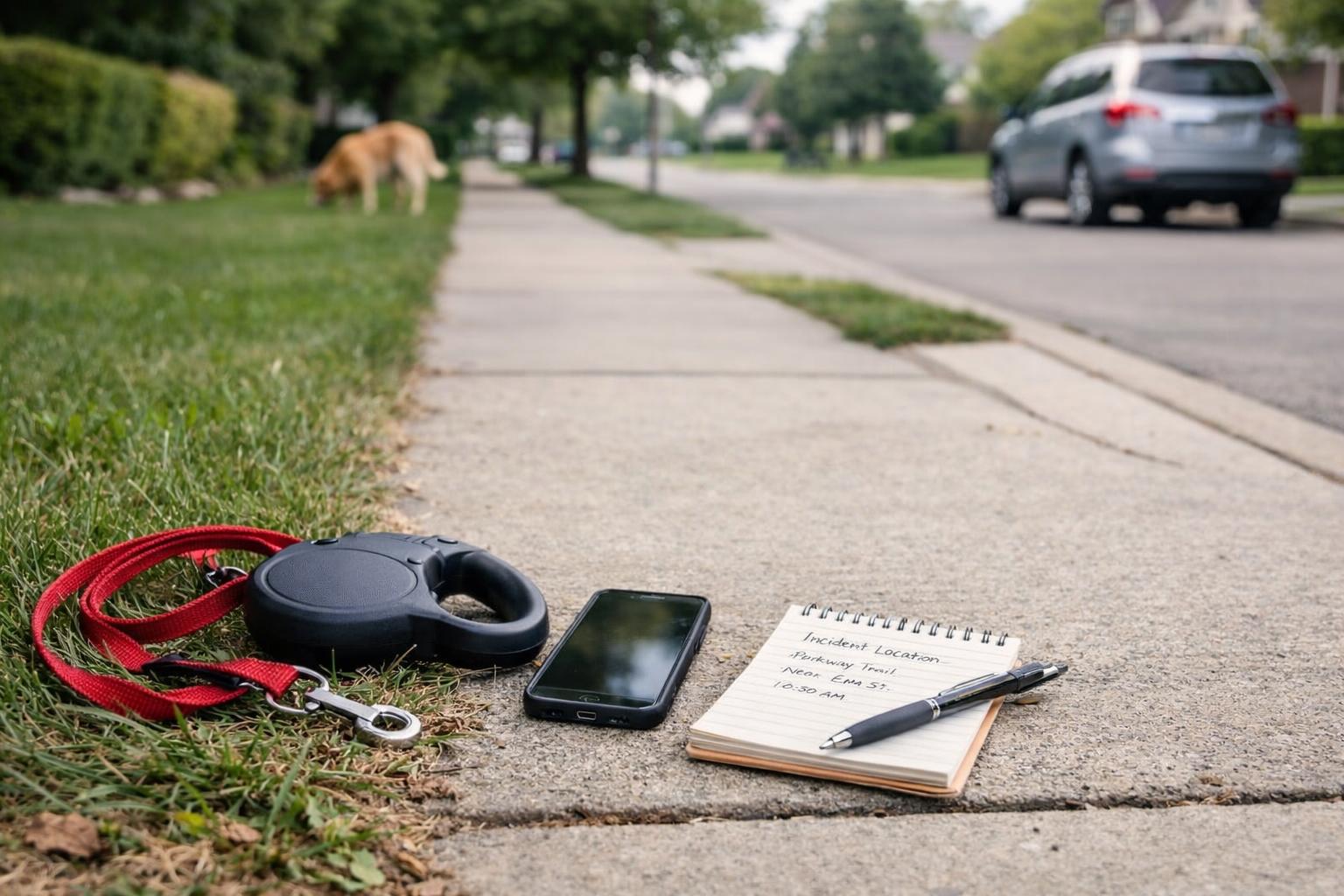
The location deserves more detail than a street name. Was the incident on a public sidewalk, in a yard, inside a home, at a business, in a common area, at a park, or near a vehicle? Identify the exact part of the property and the direction people and animals were moving. Keep the description factual.
Photograph the location only when it is safe and lawful to do so. Wide photographs can show the sidewalk, gate, fence, doorway, leash area, lighting, signs, or other physical conditions. Do not trespass, move objects, stage the scene, or include readable addresses and private information unnecessarily.
Write down the date and approximate time. Note the weather or visibility only if you personally observed it and it may explain the scene. Avoid statements such as “the owner was negligent” or “the dog was dangerous.” Those are conclusions. A useful note says what you saw: “The gate was open,” “the leash was on the ground,” or “the dog came from the driveway.”
Identify everyone present. For each witness, list the name, contact information if known, location, and what the person appeared to observe firsthand. Do not coach witnesses or coordinate accounts. A short, independent description is better than matching statements produced after discussion.
| Evidence category | What to keep | What it may clarify | What it does not prove alone |
|---|---|---|---|
| Dog and owner details | Name, contact information, dog description, tag or license details, veterinarian, and vaccination information if available. | Who owned or kept the dog and which animal was involved. | Legal responsibility, statutory exceptions, insurance coverage, or claim value. |
| Location record | Address or place, wide photographs, gate or fence condition, leash location, and a simple scene sketch. | Where people and the dog were positioned and how the event unfolded. | Trespass, fault, permission, control, or another legal conclusion. |
| Medical file | Provider names, visit records, discharge papers, prescriptions, bills, receipts, and follow-up instructions. | What care occurred and when. | Causation, medical necessity, permanence, damages, or outcome. |
| Witness and report file | Witness names, contact details, incident numbers, animal-control or police reports, and related correspondence. | Who may have information and which public agencies responded. | Admissibility, credibility, liability, or whether a claim will succeed. |
How should you take and organize non-graphic photos over time?
Photographs can help preserve appearance and timing, but they should never delay care or put you near the dog. Start only after the immediate medical needs are addressed. Use calm, clinical images rather than dramatic close-ups intended to shock.
Take an initial set in good light. Include one wider image that shows the general body area and one closer image if it can be taken respectfully. Use a plain background. Do not add filters, digital markings, captions over the image, or color correction. Keep the original files with their dates and metadata.
If the appearance changes, take follow-up images at reasonable intervals. A simple naming system helps: year-month-day, general body area, and image number. For example, “2026-07-22-left-forearm-01.” Avoid renaming the only original copy; make a working copy and preserve the source file.
Photograph damaged clothing, shoes, eyeglasses, a leash, or another physical item only if it relates to the event. Keep the item in a clean, dry, labeled container. Do not wash, repair, alter, or discard it before asking whether it should be preserved. At the same time, do not assume every item will become legal evidence.
Keep photographs of the location in a separate folder from medical images. That prevents the scene record from becoming mixed with private health information. Add a short index explaining the date, who took the photograph, and what it shows without arguing what it proves.
If another person took a photo or video, preserve the sender, original message, and file if they are willing to provide it. A forwarded or compressed copy may lose information. Do not pressure someone to create a statement or edit a video for you.
Social media is not a storage system. Posting photographs publicly can remove context, invite comments, and create copies you cannot control. Keep the file private for medical and legal review rather than using it to accuse the owner or warn the neighborhood while the facts are still being sorted out.
Which witness names, reports, and vaccination details may matter?
The CDC advises reporting dog bites to local animal control or police. In Davis County, Animal Care of Davis County says its officers respond to dog bites and attacks in every city, including Clearfield and Kaysville. The agency lists 801-444-2200 for dispatch.
Animal Care also states that a bite breaking the skin must be reported under Davis County Code and that officers investigate and quarantine the dog for rabies observation. Reporting serves a public-health and animal-control function. It is separate from whether you have a civil claim.
When you report, provide the facts you know: where and when the incident happened, the dog’s description, owner information, witness details, whether the skin was broken, and where the dog may be located. Do not guess at vaccination status or breed. Ask for an incident or report number and write down the agency, date, and person you spoke with.
If police also respond, preserve the agency name, incident number, officer information if provided, photographs, and any written notice. Do not assume a report determines civil liability. A report records what the agency received or observed; its legal effect depends on the facts and rules.
Vaccination details matter because a healthcare provider or public-health agency may need them. Keep any rabies-certificate information, veterinarian contact, tag number, quarantine notice, or agency correspondence. Do not attempt to verify vaccination status by contacting the dog directly or entering private property.
Witnesses may include a neighbor, passerby, delivery worker, property manager, business employee, family member, or first responder. Keep their information in one list. Separate firsthand observations from what they learned later. “Saw the dog leave the open gate” is different from “heard the owner say the gate had been open.”
If you do not know the owner, the report and location information become especially important. Provide the best description available and preserve any nearby camera information you already know about. Do not demand footage, accuse a particular resident, or conduct your own surveillance operation.
What medical, billing, work, and insurance records should you keep together?
Create a provider index. List every urgent-care, emergency, primary-care, specialist, imaging, pharmacy, therapy, or other provider connected to the incident. Include the address, approximate dates, and the general reason for the visit. Keep medical notes and bills as separate document types because the clinical record and charge record may arrive from different organizations.
Store every bill, receipt, prescription expense, supply cost, and explanation of benefits. Do not assume an explanation of benefits is the same as a bill or proof of payment. Mark whether an item was billed, paid, adjusted, denied, or still pending only if the document shows that status.
If work was affected, keep employer communications, schedules, time records, pay stubs, leave documents, and any provider restriction already issued. Do not calculate a wage-loss claim from memory. Preserve the source records and let the legal and financial questions be reviewed separately.
Keep a simple daily-life note if the injury affected ordinary activities. Use dates and concrete examples: “could not wear work glove,” “missed scheduled shift,” or “returned for follow-up because swelling increased.” Avoid diagnosing yourself, predicting permanence, or copying language from a legal website.
For insurance, keep every letter, email, claim number, adjuster name, request, recorded-message notice, authorization, offer, denial, reservation, and proposed release. Do not rely on a phone call alone. After a call, write the date, number, person, and subjects discussed.
This article does not tell you whether to give a statement, sign an authorization, accept an offer, or refuse a release. Those decisions depend on the request, the policy, the parties, the medical record, and the legal issues. Preserve the document exactly as received and ask for review before making assumptions.
A Clearfield personal-injury lawyer will usually need the complete chronology, not a folder containing only the most dramatic photograph. Gibb Law’s broader personal-injury page explains the service context, while the dog-bite page focuses on this type of incident.
What should you avoid saying or doing while the facts are being reviewed?
Do not confront the owner or approach the dog. A demand for an apology, a threat to sue, a neighborhood post, or an attempt to recreate the event can create safety and documentation problems. Use official reporting channels and let direct communication be reviewed before it escalates.
Do not exaggerate. A calm record is more useful than a dramatic one. If you do not know whether the dog was vaccinated, say that. If you are unsure about the time, give a range. If you did not see who opened a gate, do not assign responsibility in your notes.
Do not delete inconvenient messages or edit photographs. Preserve complete threads, even when a message is emotional or unhelpful. A selective record can be harder to evaluate than an honest one.
Do not assume Utah’s statute is exception-free. Current Utah Code Section 18-1-1 generally makes an owner or keeper liable for injury caused by a dog without requiring proof that the dog was previously vicious or mischievous, but the statute now contains express exceptions. Whether the general rule or an exception applies requires legal review.
Do not assume breed proves liability or that the absence of a prior bite defeats every issue. Do not tell an insurer, owner, landlord, business, or government entity that responsibility is already established. The identities, property relationship, dog control, location, statutory language, and other facts still matter.
Do not treat medical records or photographs as a guaranteed result. They can document care and appearance. They do not automatically prove legal responsibility, causation, damages, insurance coverage, or claim value.
Do not calculate a legal deadline from a generic internet answer. Different parties, claims, government involvement, ages, and other rules can affect timing. Ask about deadlines early, but do not publish or rely on a universal date.
Protect health first
Follow medical and public-health guidance before collecting scene details or contacting anyone.
Record neutral facts
Dog, owner, place, time, witnesses, treatment, reports, and insurance communications.
Preserve originals
Complete messages, original photographs, reports, medical records, bills, and physical items.
Separate proof from outcome
Useful records support review; they do not guarantee liability, coverage, compensation, or settlement.
What should you bring to a Clearfield dog-bite consultation?
Bring the medical record you have so far: discharge papers, provider list, prescriptions, appointment information, bills, receipts, and follow-up instructions. If more records are still coming, bring an index showing what has been requested.
Bring the photographs in original digital form when possible, along with an image index. Include location photographs, clothing or item photographs, and medical photographs kept in a private folder.
Bring the owner and dog information. That can include names, addresses, phone numbers, veterinarian or vaccination details, license numbers, property contacts, and your neutral description of the dog. Mark unknown items instead of guessing.
Bring the report file: Animal Care of Davis County incident number, police incident number if any, agency correspondence, quarantine or vaccination information, and witness contacts.
Bring insurance communications exactly as received. Include the claim number, adjuster contact, letters, emails, requests, authorizations, statements, offers, and releases. Do not summarize away the wording.
Bring a one- or two-page chronology covering the incident, care, reporting, follow-up, work effects, and major communications. A dated list helps the first conversation stay focused.
You can review Gibb Law’s Clearfield practice areas and Dustin Gibb’s profile before deciding whether to bring the file in. The first conversation should help identify what is known, what is missing, and what questions need legal review. It should not promise a result.
Frequently asked questions about Utah dog bite evidence
Do I need to report a dog bite in Davis County?
Animal Care of Davis County states that a bite breaking the skin must be reported under county code and that its officers respond to dog bites and attacks throughout Davis County. The agency lists 801-444-2200 for dispatch. Call 911 for an emergency.
What owner and vaccination information should I try to obtain?
If it can be obtained safely, keep the owner’s name, address, phone number, veterinarian name, rabies-license number, vaccination information, and a description of the dog. Do not approach the dog, enter property, or confront the owner to get missing details.
Can photos taken days after a bite still be useful for review?
Follow-up photographs can document changes over time when they are taken calmly and kept with their original dates. They should not delay care, be filtered or edited, or be treated as proof of liability or claim value.
What if I do not know who owns the dog?
Preserve the exact location, time, dog description, witness information, photographs, and local report number. Give accurate information to animal control or police rather than conducting your own confrontation or investigation.
Does Utah law require proof that the dog bit someone before?
Utah Code Section 18-1-1 generally does not require proof that the dog was previously vicious or mischievous or that the owner knew it. The current statute contains express exceptions, so the specific facts still need review.
Should I send medical records or a statement directly to an insurance company?
Preserve the request and the claim information, but do not use this article to decide whether to provide a statement, sign an authorization, or send a particular record set. Those are fact-specific insurance and legal questions.
Want help turning scattered records into a clear file?
For a Utah dog bite involving Clearfield or Davis County, bring the medical records, photos, witness names, owner information, reports, and insurance letters. If you have questions, let’s talk it through. Free call: (801) 725-6035.
Talk with Gibb Law about what to preserve