Easement Dispute Mediation: When a Practical Access Agreement May Beat a Lawsuit
Neighbor blocking or misusing an access easement? Here's when a written access agreement through mediation may beat a Utah lawsuit, and what to bring.
Easement Dispute Mediation: When a Practical Access Agreement May Beat a Lawsuit
Stuck in an access fight with a neighbor? Maybe it’s a truck parked across the shared lane again, a new gate, or a snowplow pile dumped right where you need to drive. If you’re in Kaysville, Clearfield, or elsewhere in Davis County, there may be a quieter path than a lawsuit. A mediated, written, recorded access agreement can settle how a shared driveway or access strip works day to day, without a judge deciding it for you.
That isn’t always the right answer. Mediation can’t fix a real question about who owns the land, and it won’t work if your neighbor refuses to take part. But when both of you mostly want the arguing to stop, an agreement you write together can be more practical than a ruling neither of you chose.
What matters most
- In mediation, you write the deal.Utah Courts says the mediator is neutral and the final agreement isn’t imposed on you. The parties design it.
- You don’t need a lawsuit to mediate.If no case is pending, Utah Courts says you can contact a mediator on your own.
- A handshake isn’t enough for land.Utah’s statute of frauds generally requires a signed writing to create an interest in real property.
- Recording is what tells the next buyer.Under Utah Code 57-3-102, a properly recorded document gives notice of its contents to everyone from the time it’s recorded.
First, is this really an easement problem?
Neighbors use “easement” for a lot of things. Before you pick a path, it helps to name what you’re actually arguing about, because each kind of dispute calls for different tools.
- Use: You agree there’s a right of access, but you disagree about how it’s used: parking, gates, width, guests, delivery trucks.
- Boundary: You disagree about where the property line actually is.
- Ownership: Someone claims they own part of the land, not just a right to cross it.
- Nuisance: The fight is about noise, runoff, lights, or other interference, not access.
- Contract: There’s a written agreement, maybe from a prior owner, and the question is what it means.
- Money only: Someone wants to be paid back for repairs, paving, or damage.
Mediation tends to fit the first and fifth best: disagreements about how a shared access should work, between people who’ll keep living next to each other. It’s a much harder fit when the real question is whether a strip of land belongs to you at all.
Utah’s district courts sort these into different case types. Their filing guide lists a “Property Rights” case type for disputes over the ownership, use, boundaries, or value of real property. It lists “Contracts” separately. Small claims is a different track again, limited to collecting money owed up to $10,000.
What does your easement actually allow today?
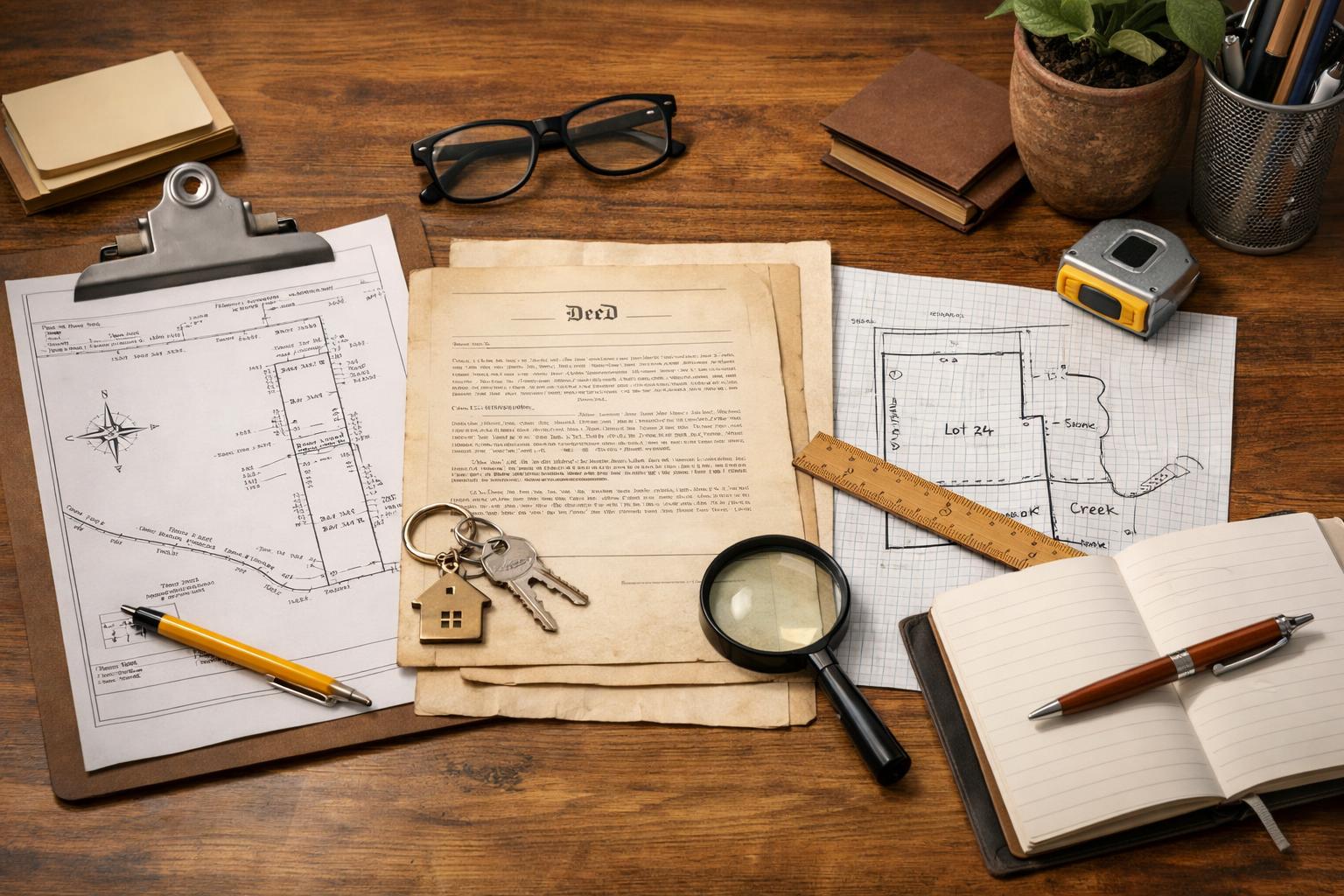
Before any conversation with your neighbor, or with a mediator, find out what’s actually on record. I’d start with these, in roughly this order:
- Your deed, and your neighbor’s if you can get it.
- Any recorded easement, right-of-way, or access agreement.
- The subdivision plat, if your lots are part of one.
- Any survey of either property.
- Your title insurance policy from when you bought, which often lists recorded easements.
In Davis County, those land records live with the Davis County Recorder’s Office at 61 South Main Street in Farmington, in the County Administration Building. The office says its land records go back to 1870 and are public, so anyone can view them. The office also says plainly that it doesn’t give legal advice. Its staff can help you find a document. Reading what the document means for your driveway is a different job.
What you’re looking for is the actual language. Does it describe a specific strip by measurement, or just “access”? Does it mention maintenance, parking, or gates? Does it say who it benefits? Many disputes shrink once both neighbors read the same recorded page. Some get sharper. Either way, you’ll know what you’re working with.
If your situation looks more like a boundary or title problem than an access disagreement, our Property Disputes in Utah page covers those disputes more broadly.
What people commonly get wrong about easement disputes
A lot of neighbor fights get harder than they need to be because of assumptions about how property rights work. These are the ones worth clearing up before you decide anything.
“The old owner said we could use it, so we have an easement.”
Maybe. Maybe not. Utah Code 25-5-1 says an interest in real property, other than a lease of a year or less, generally can’t be created except by a signed writing or by operation of law. A verbal “go ahead and use it” from a previous owner usually isn’t that writing. There are situations where the law can recognize access rights without a signed document, but those turn heavily on facts and court decisions. Don’t assume either way. Have someone look at the history.
“Mediation means I give in.”
No. Utah Courts describes mediation as collaborative. The mediator doesn’t decide who’s right, and the agreement isn’t imposed. You and your neighbor design it. If it isn’t productive, either of you can end it. If no agreement is reached, a case that’s already filed simply returns to litigation.
“If we sue, we skip all that.”
Not necessarily. Under Utah’s Code of Judicial Administration Rule 4-510.05, once a responsive pleading is filed in district court, cases covered by the rule are referred to the court’s ADR program. The exceptions are parties who’ve already used another ADR process, parties the court excuses, and case types exempt under Rule 4-510.06. Filing a lawsuit can put you in front of a mediator anyway, just with a lawsuit running alongside.
“We shook on it, so it binds whoever buys the house.”
That’s the riskiest assumption of all. An unwritten deal may not count as an interest in land in the first place. And even a written one does its best work when it’s recorded. Utah Code 57-3-102 says a properly executed and acknowledged document gives notice of its contents to all persons from the time it’s recorded with the county recorder. If your neighbor sells, the next owner’s title search is where they’ll find your agreement, if it’s there.
“Recording a document proves I’m right.”
Recording gives notice. It doesn’t settle who’s right. The Davis County Recorder’s Office says it doesn’t give legal advice and doesn’t accept responsibility for disputes that come up over recorded documents. A recorded paper that’s poorly drafted, or that conflicts with an earlier one, can still be fought over.
“Small claims can sort this out cheaply.”
Small claims is for money owed, up to $10,000, according to Utah’s district court filing guide. If what you need is a clear rule about who can use the lane and how, that’s not a small-claims question.
What this guide is based on: The mediation details are taken from the Utah Courts Mediation / Arbitration pages, including the court’s civil ADR page describing Rule 4-510.05. Case types come from the Utah Courts guide, Case and Filing Types in Utah District Courts (April 2026). Property rules come from Utah Code 25-5-1 and Utah Code 57-3-102. Recording details come from the Davis County Recorder. None of this predicts how a particular dispute will turn out.
Mediation, the court’s ADR program, or a lawsuit?
There are really three or four ways an access dispute can move forward. They aren’t mutually exclusive, and the right one depends on how far things have already gone.
| Path | Who decides | What it can produce | Worth knowing |
|---|---|---|---|
| Mediation before filing | You and your neighbor, with a neutral mediator’s help | A written agreement you both sign, which can then be recorded | You can hire a mediator from the Utah Courts roster, which lists each mediator’s expertise, location, and maximum hourly fee. The court says the roster isn’t an endorsement. |
| Community mediation | You and your neighbor | A written agreement | Utah Dispute Resolution is a nonprofit that offers mediation on a sliding fee scale. Its center is in Salt Lake City, and it offers mediation online throughout Utah. |
| Court ADR after filing | Still the parties, unless no agreement is reached | A settlement, or the case returns to litigation | Under Rule 4-510.05, covered district court cases are referred to ADR after a responsive pleading. Discovery can keep going during mediation. |
| Lawsuit | The court | A court ruling on the dispute | Utah’s district court guide lists Property Rights cases as those involving the ownership, use, boundaries, or value of real property. |
On cost, Utah Courts says ADR is paid by the people in the dispute, usually split equally or by agreement. A party who can’t afford it can ask the court to waive all or part of the fees. Utah Courts also describes mediation as an option that can be faster, cheaper, and more satisfying than litigation. “Can be” is the honest phrase. It depends on whether both of you show up ready to solve the problem.
When a mediated access agreement is likely to fit, and when it won’t
Signs mediation may be worth trying
- You both agree there’s some right of access. The fight is over how it’s used.
- You expect to keep living next to each other for years.
- The problems are practical: snow removal, parking, a gate, who fixes the potholes, delivery trucks.
- Your neighbor has at least been willing to talk, even if it’s been tense.
- Neither of you wants to spend what a full lawsuit would cost.
Signs it probably won’t be enough
- Your neighbor won’t respond at all, or has said they won’t negotiate.
- You’re cut off from your property right now, and waiting isn’t realistic.
- The real dispute is who owns the strip, or where the boundary sits.
- There are conflicting recorded documents, and you need a court to say which one controls.
- There have been threats, property damage, or safety concerns.
Even in the second group, mediation sometimes still has a role later, after the legal question is narrowed. It just shouldn’t be the only plan.
How to get ready for a mediation session
Showing up prepared is the part you control. A mediator can help two people talk, but they can’t make up for missing paperwork or a vague sense of what you want.
Bring the documents, not just the story
Have the recorded easement, the plat, any survey, and a few dated photos with you. If there’s a disagreement about where the lane runs or how wide it is, a survey or plat is worth more than an hour of back-and-forth.
Separate your must-haves from your nice-to-haves
Before the session, write down the two or three things you can’t live without. Maybe that’s year-round access for your car and a clear lane in winter. Then list the things you’d like but could trade, like where guests park or who pays for gravel. People who walk in knowing the difference tend to walk out with something workable.
Think about what your neighbor needs
This isn’t about being generous. It’s practical. If your neighbor’s real worry is strangers using the lane, or a gate that keeps their dog in, an agreement that addresses that is far more likely to get signed.
Know what happens next if a case is already filed
If you’re mediating inside a lawsuit, Utah Courts says that when the ADR process ends, the plaintiff notifies the court of the outcome on a court form. If you settle, the agreement still needs to be put in proper written form, and recorded if it affects the land.
Neighbors usually don’t need a judge to tell them who’s a good person. They need a page that says who plows, where the truck parks, and what happens when the house sells. If you can get that page signed and recorded, you’ve solved the problem that will still be there in ten years.
Putting an access agreement in writing so it lasts
An agreement reached in mediation is only as useful as the paper it ends up on. Two Utah rules shape this. Interests in land generally need a signed writing under Utah Code 25-5-1, and recording with the county recorder gives notice to everyone, including future buyers, under 57-3-102.
The exact drafting is where a lawyer earns their fee, because recording rules and the effect of an agreement depend on how it’s written. Here are the practical topics I’d want any access agreement to address:
- Where exactly the access runs, tied to a legal description or survey, not “the gravel lane.”
- Who may use it: owners, family, guests, delivery and service vehicles.
- Parking: whether it’s allowed anywhere on the access, and for how long.
- Gates, fences, and anything else that could block passage.
- Maintenance, repairs, and snow removal, including who pays and how costs are split.
- What happens when either property is sold.
- How you’ll handle the next disagreement, so it doesn’t become another standoff.
Once it’s signed, it goes to the Davis County Recorder’s Office in Farmington to be recorded against the right parcels. Check with the recorder’s office on its current requirements and fees before you go.
When a lawsuit is still the right path
Sometimes the most realistic plan is to file. If access to your home is blocked now, if your neighbor won’t engage at all, or if you’re facing a genuine fight over ownership or the boundary, a mediated agreement may not get you there.
Filing doesn’t guarantee any particular result. Not every neighbor disagreement supports a lawsuit, and not every lawsuit leads to a court order. Before deciding, a lawyer should review the recorded documents, any survey, your title records, any written agreements, and the photos and messages that show what’s actually been happening. That review is what tells you whether you have a strong legal position or just a strong grievance. Those are not always the same thing.
And remember the earlier point: in district court, a covered case may be referred to mediation anyway once it’s answered. Filing and mediating aren’t opposites. Sometimes the lawsuit is what finally brings the other side to the table.
What to bring to a property-dispute consultation
If you bring these, we can spend our time on your options instead of on finding papers.
- Your deed, and any recorded easement or access agreement.
- The plat map and any survey you have.
- Your title insurance policy or commitment from your purchase.
- Any written agreement with this neighbor or a prior owner.
- Dated photos of the access, the blockage, or the damage.
- Texts, emails, or letters between you and your neighbor.
- Notes on what you want: shared use with clear rules, a defined route, maintenance help, or something else.
Questions worth thinking about beforehand: How long has the access been used the way it is now? Has anything changed recently, like a sale, new construction, or a new fence? Have you and your neighbor ever agreed on anything in writing?
Questions about easement mediation in Utah
Do I have to file a lawsuit before I can use mediation?
No. Utah Courts says that if your dispute isn’t part of a pending case, you can contact a mediator on your own. The court roster lists mediators by expertise, location, and maximum hourly fee.
Is what we say in mediation confidential?
Utah Courts describes mediation as confidential, along with informal and collaborative. If confidentiality matters a lot in your situation, ask the mediator about it at the start.
Does our agreement need to be written and recorded?
Writing it down matters because Utah Code 25-5-1 generally requires a signed writing to create an interest in real property. Recording matters because Utah Code 57-3-102 says a recorded document gives notice of its contents to everyone from the time it’s recorded. That includes future buyers.
What happens if mediation doesn’t work?
Either party can end mediation if it isn’t productive. If a case has already been filed and no agreement is reached, Utah Courts says the court is notified and the case returns to litigation. If nothing is filed yet, you can decide your next step from there.
Who pays the mediator?
The people in the dispute. Utah Courts says fees are usually split equally or by agreement. In court-referred ADR, a party can ask the court to waive all or part of the fees. Utah Dispute Resolution offers a sliding fee scale.
My neighbor has used part of my land for years without asking. Do they have an easement now?
That depends on the facts and on Utah court decisions about long-term use. It isn’t something to answer from a general article. Bring the history, including how long the use has gone on and whether anyone ever gave permission, to a consultation.