Changing a Custody or Support Order in Utah: What to Know Before You Start
Custody and support changes require facts, documents, and a clear reason. Learn what to organize before asking about a Utah modification.
Here’s where I’d start: before you ask to change a custody or support order in Utah, read the exact current order. Then identify what changed, when it changed, whether it is ongoing, and which records support the change. In Clearfield and Davis County, that usually means bringing the controlling order, parenting calendars, child-related records, income documents, and a simple timeline to the first conversation.
A new job, relocation, schedule problem, income shift, or changing child need may be important. It does not automatically mean the court will modify the order. The first task is to sort out whether the issue is custody, parent-time, child support, alimony, enforcement, or more than one of those questions.
- What is the title, date, court, case number, and exact language of the controlling order?
- Are you asking to change custody, parent-time, child support, alimony, or another part of the decree?
- What changed after the order, and what records show the date and practical effect?
- Is the change ongoing, expected to last, or temporary?
- Have both parents continued to follow the current custody, parent-time, and support terms?
- Did the order come from Utah, or does another state or an out-of-state parent or child affect jurisdiction?
What does your current Utah order actually require right now?
Start with the signed, filed order that currently controls. That may be a divorce decree, custody and parent-time order, parentage order, child-support order, alimony order, stipulated modification, or later order changing only one part of the original decree. Do not rely on an unsigned draft, a memory of what was said in court, or the schedule the family has been using informally.
Read every child-related section. Identify legal custody, physical custody, the parent-time schedule, holiday and summer provisions, exchange terms, school and activity decisions, travel, communication, childcare, health expenses, child support, and any dispute-resolution or notice requirements. A request to change one part can affect others.
Utah Courts explains that modifying custody also means modifying child support and parent-time. That does not mean every custody request changes every number or schedule. It means the issues are connected and the proposed change should be evaluated as a complete child-related arrangement.
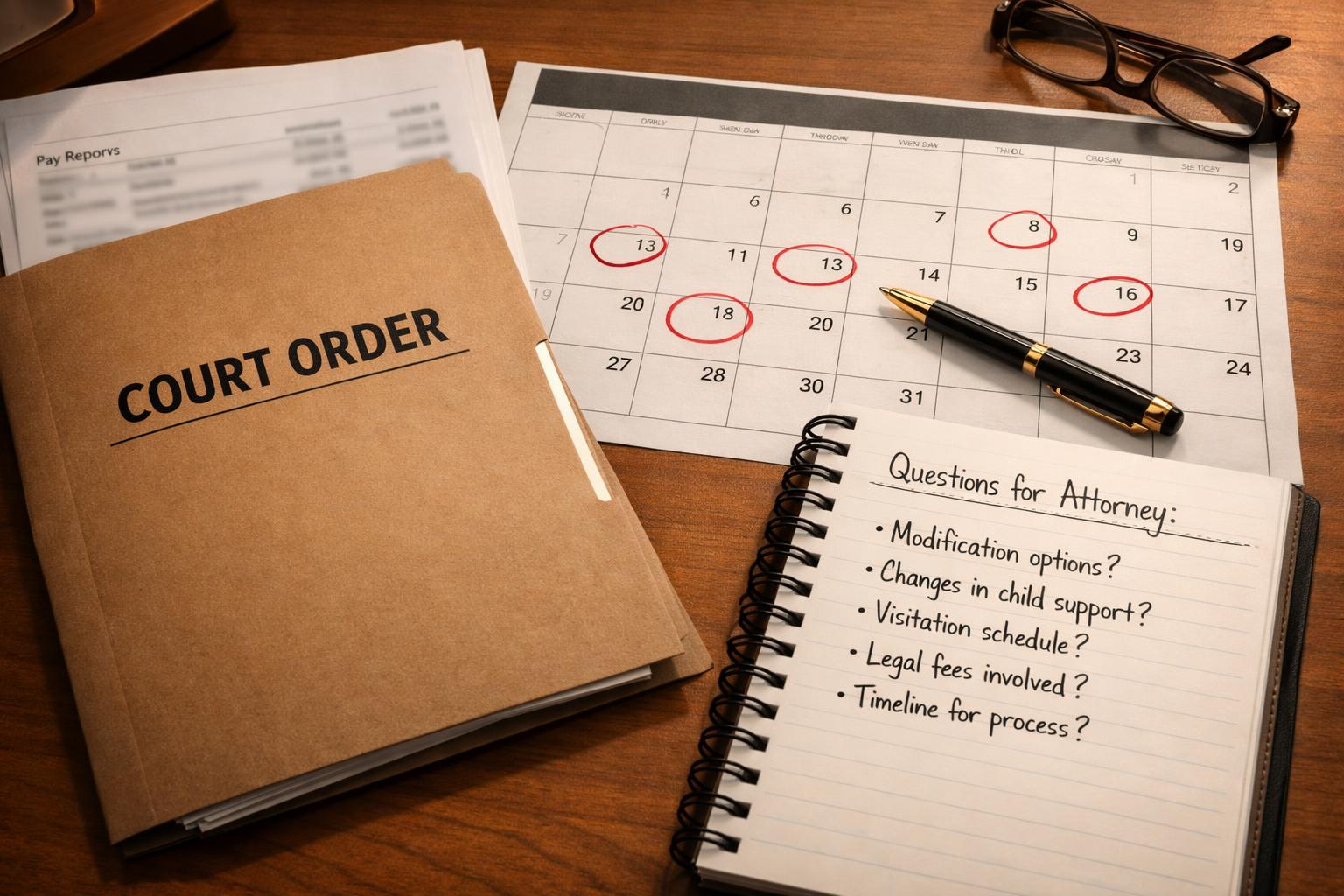
Create an order index. List the title, date, court, case number, parties, and the sections you believe no longer fit. If there were later orders, put them in date order and note which paragraphs they changed. A clean index prevents an older provision from being treated as current after it was modified.
Utah Courts also says parties must obey the existing custody, parent-time, and support orders. Parent-time and support should not be withheld in response to the other issue. That is an important separation: a dispute about unpaid support does not automatically authorize withholding parent-time, and a parent-time dispute does not automatically authorize stopping support.
If you believe an emergency changes what can safely happen, do not use this article to choose a self-help response. Bring the order and the specific facts to counsel so the lawful emergency or temporary process can be evaluated.
Gibb Law’s divorce-procedures page provides general context for Utah family cases, while the controlling order in your own file remains the place to begin.
Source basis: the custody discussion follows the official Utah Courts modifying-custody guidance. The support discussion follows the Utah Courts modifying-child-support guidance, and current statutory confirmation comes from Utah Code Section 81-6-212. These sources describe general standards and filing paths; they do not determine whether a Clearfield parent qualifies for a change.
Custody modification
Core question: Have substantial material changes occurred since the order, and would a change be in the children’s best interests?
Records: Controlling order, parenting history, calendars, school and child-related information, communications, and a dated change timeline.
Parent-time modification
Core question: Is the requested change primarily about schedule, exchanges, holidays, travel, communication, or another parent-time term?
Records: Current schedule, actual calendar, missed or changed exchanges, notices, travel and activity information.
Child-support change
Core question: Which support-change path applies, what do current guideline calculations show, and is the difference temporary?
Records: Current order, tax returns, pay information, income sources, childcare, insurance, and guideline inputs.
Enforcement question
Core question: Is the problem that the current order is not being followed rather than that its terms should change?
Records: Exact order language, payment or calendar history, notices, communications, and specific claimed violations.
Are you asking about custody, parent-time, support, enforcement, or more than one issue?
People often say, “I need to change the decree,” when the actual problem is narrower. Naming the issue correctly helps you gather the right records and avoid using the wrong form or process.
A custody question concerns legal or physical custody. A parent-time question concerns the schedule and related terms. A child-support question concerns the support obligation and guideline information. An alimony question is different again. An enforcement question asks the court to address noncompliance with the existing order rather than replace the term.
Sometimes the issues overlap. A proposed custody change may require a new parent-time schedule and a support calculation. A relocation concern may affect exchanges, travel costs, school, and communication. A changing work schedule may raise both parent-time and childcare questions. The overlap should be identified, not hidden inside one general request.
Do not assume enforcement and modification are interchangeable. If the current order still fits but the other parent is not following it, the question may be enforcement. If the order no longer fits because circumstances materially changed, the question may be modification. The same facts can raise both questions, but each needs its own legal analysis.
Also separate a support adjustment from a full modification petition. Utah Courts describes two paths for changing child support: a Motion to Adjust and a Petition to Modify. A motion is simpler but available only in limited circumstances. The age of the order, size of the guideline difference, expected duration of the change, and other facts affect which path may be available.
A Clearfield family-law attorney can help classify the issue before forms are prepared. Gibb Law’s child-custody page and alimony-and-support page provide service context, but they do not determine the right procedural path for a specific order.
Write one sentence for each requested change. For example: “I want the weekday schedule reviewed because my work hours changed on March 1,” or “I want child support reviewed because the current guideline inputs may no longer match the parties’ ongoing incomes.” That is more useful than “everything needs to change.”
What changed, when did it change, and is the change ongoing?
A modification conversation begins with the difference between the circumstances when the order was entered and the circumstances now. The comparison needs dates and records. “Things are different” is not enough to evaluate the legal standard.
Utah Courts says a party seeking a custody or parent-time modification must show substantial material changes since the order and that the requested change would be in the children’s best interests. This article cannot tell you whether a particular job, move, school issue, health concern, remarriage, new child, schedule conflict, or parenting disagreement meets that standard.
Build a change timeline. Start with the order date. Then list each event that may matter: job change, work-schedule change, move, school enrollment, activity schedule, childcare shift, health or developmental information, missed exchanges, changed household circumstances, or a new pattern of communication. Include the source document for each item.
Separate a temporary event from an ongoing one. A short project assignment, seasonal overtime, temporary layoff, brief medical leave, or temporary housing issue may be different from a permanent schedule, sustained income change, completed relocation, or long-term child need. Describe what is known and what remains uncertain.
For custody, connect the changed circumstance to the child-related term you want reviewed. Do not turn the timeline into a character attack. “The other parent is impossible” does not explain the requested schedule. “Since the school change, the current weekday exchange occurs after the child’s school start time twice each week” identifies a practical issue.
For support, connect the change to the guideline inputs. Income, childcare, insurance, and other authorized inputs may matter. Do not rely on a social-media estimate or an informal promise. Use source documents and the current Utah calculation process.
Keep a separate section for disputed facts. If the parents disagree about income, residence, schedule use, expenses, or the child’s needs, identify the disagreement without presenting your conclusion as established. A lawyer can then ask what additional record would clarify it.
| Question to document | Useful records | What the records may clarify | What they do not decide alone |
|---|---|---|---|
| What order controls? | Signed decree, custody order, parenting plan, support order, and every later modification. | The terms in effect and the provisions that may need review. | Whether a requested change will be granted. |
| What changed? | Dated timeline, employment records, residence records, school or childcare information, and communications. | When the difference began and whether it appears ongoing. | Whether the change is legally substantial or material. |
| How has parenting operated? | Actual calendar, exchanges, holidays, travel, school attendance, activities, and notices. | The difference between the written schedule and the family’s actual pattern. | Which future custody or parent-time arrangement is in the child’s best interests. |
| What changed financially? | Tax returns, pay stubs, income records, childcare, insurance, and current support calculations. | The inputs available for a support review. | The final support amount, effective date, arrears, or retroactivity. |
Which parenting calendars and child-related records should you organize?
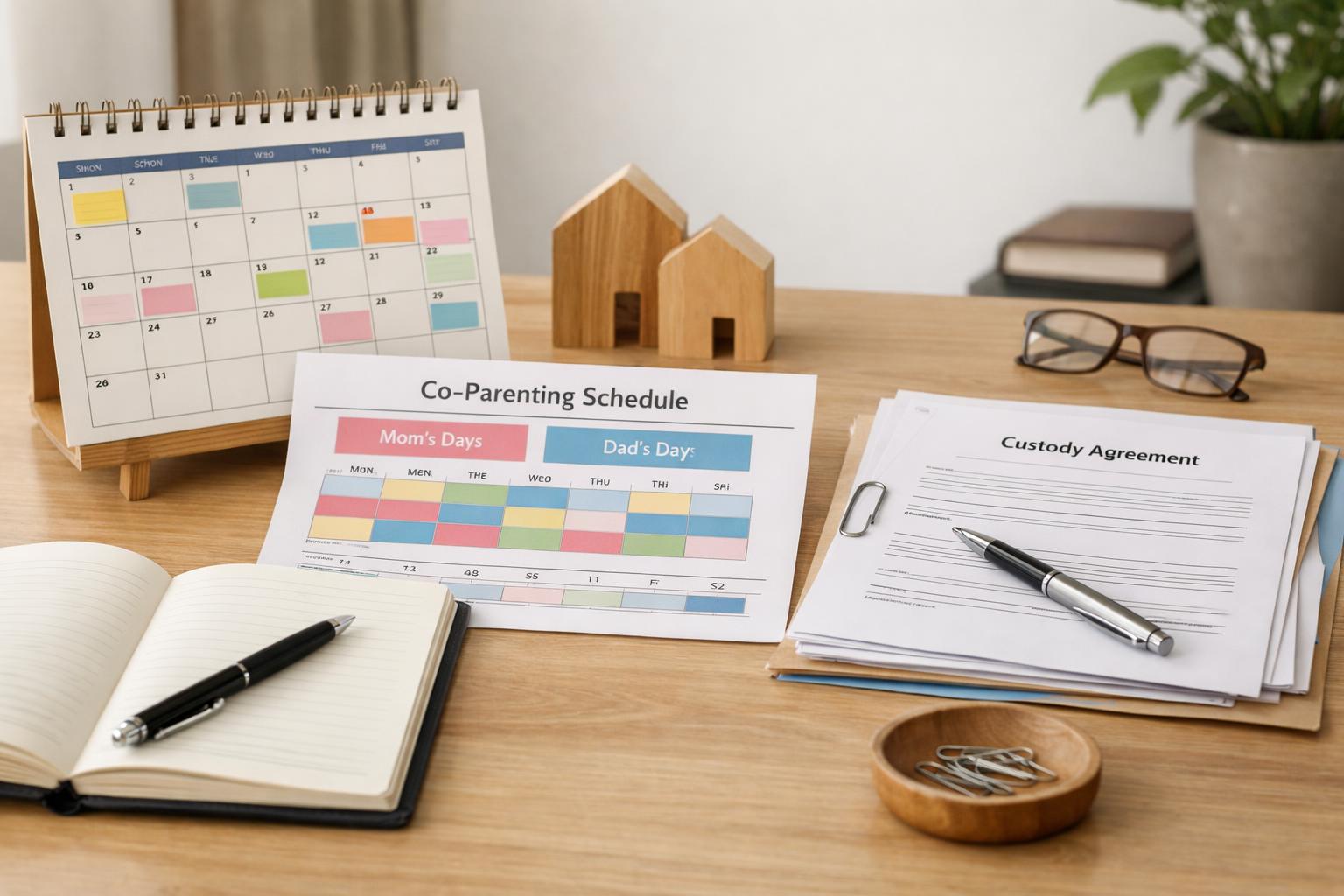
Start with the written schedule. Create a clean calendar showing the custody and parent-time arrangement required by the order. Then create an actual-use calendar showing what happened. Keep those two layers separate so the reviewer can see both the obligation and the practice.
For each exchange, record the date, scheduled time and place, actual time and place, who transported the child, and any relevant notice. Avoid emotional commentary. “Exchange occurred at 7:20 p.m. instead of 6:00 p.m.; message sent at 5:35 p.m.” is easier to evaluate than “always late and disrespectful.”
Include holidays, school breaks, summer time, travel, birthdays, and special provisions. Many disputes appear simple until the holiday and summer language is compared with the regular schedule.
Collect school records that connect to the issue: calendars, attendance, enrollment, transportation, teacher communications, activity schedules, and special-service records already available to you. Do not obtain private information unlawfully or ask school staff to take sides.
Collect health, therapy, or developmental information only when it is relevant and lawfully available. Preserve provider names, appointment dates, recommendations, and communications. Do not diagnose the child or use an article to decide what treatment is needed.
Keep childcare and activity records if the proposed change affects them. Include provider schedules, costs, enrollment, transportation, and parent communications. A support question may require financial documentation, while a parent-time question may focus on logistics and consistency.
Preserve complete communication threads. Parenting applications, texts, emails, school messages, and calendar invitations can show notice and scheduling history. Do not edit messages, delete unfavorable portions, or ask the child to carry messages between parents.
Build a witness list only for people with firsthand information, such as a childcare provider, teacher, coach, family member involved in exchanges, or another person who directly observed a relevant event. Do not coach the witness or turn ordinary community relationships into a campaign.
The purpose of the file is not to prove that one parent is good and the other is bad. It is to explain the order, the change, the actual child-related pattern, and the practical question the court may need to address.
Which income records and guideline information matter for a support question?
Child support should begin with the current order and current source documents. Utah Courts lists two years of tax returns and the most recent pay stub as proof of income for child-support modification forms. Depending on the work and income pattern, a complete review may require more information.
Gather W-2s, 1099s, recent pay stubs, tax returns with schedules, business records if self-employed, benefit statements, unemployment records, bonus or commission information, and documentation of other income sources. Do not select only the month that best supports your position.
Collect work-related childcare and health-insurance information that may be relevant to the guideline calculation. Include provider statements, invoices, proof of payment, coverage records, and the child’s portion when it can be identified from the source.
Utah Courts describes a 10% difference requirement for child-support changes and says the difference cannot be temporary; it defines temporary as expected to last less than one year. That is a screening rule, not a promise that a modification will be granted.
A Motion to Adjust may be available when the order is at least three years old, the guideline difference is 10% or more, the difference is not temporary, and the proposed amount is consistent with the guidelines. When the order is less than three years old, Utah Courts describes a petition path involving at least a 15% guideline difference and a listed material change.
Do not perform that calculation from incomplete income guesses. The percentage comparison requires a current guideline amount and a reliable current-order amount. The proper income figure can itself be disputed when work is seasonal, self-employment is involved, compensation varies, or a parent is underemployed.
Do not assume that meeting a percentage threshold establishes the effective date, arrears, retroactivity, fees, or final amount. Those questions require the current statutes, procedural posture, filings, service, and case-specific facts.
Keep alimony separate from child support. An income change may raise both questions, but the standards, factors, and order language are different. Bring the complete decree and financial records rather than asking one calculation to answer both.
Why can informal changes create risk even when both parents initially agree?
Families often adjust schedules without returning to court. A work shift changes. A child joins an activity. One parent moves closer. The parents trade weekends or change exchange times. A practical agreement can help day-to-day life, but it does not automatically replace the court order.
Utah Courts says parties must continue to follow the current custody, parent-time, and support orders. That means a long-running informal arrangement should not be treated as a filed modification simply because both parents once agreed to it.
The risk appears when memories differ or circumstances change again. One parent may view the arrangement as temporary while the other views it as permanent. A text may address one weekend, not the entire schedule. A support payment may have been changed informally without a clear record of what the payment covered.
Keep the written history. Preserve the complete conversation, date, proposed duration, schedule, and any later objection. If the arrangement affects support, childcare, insurance, travel, or school, preserve those records too.
Do not use informal change as permission to stop following another part of the order. Parent-time and support are separate obligations. A dispute over one does not automatically cancel the other.
If both parents now agree that a lasting change is appropriate, ask what process is needed to put the agreement into a new court order. Do not assume that a signed note, text exchange, or parenting-app entry has the same effect as a court-approved modification.
If the parents disagree, do not escalate through the child, school, employer, or public posts. Keep the communication factual and focused on the current order while the legal options are reviewed.
The issue is not that informal flexibility is always wrong. It is that the legal order and the actual arrangement can drift apart. The farther apart they become, the more important it is to document what happened and ask how the order should be addressed.
What should you ask before filing anything in Davis County?
Ask which order controls and which provisions are being changed. Bring every later order so the review does not start from language that is no longer current.
Ask whether the facts raise modification, adjustment, enforcement, temporary-order, jurisdiction, or another procedural question. The correct form depends on the issue.
Ask what legal standard applies. For custody, discuss substantial material changes and the children’s best interests. For support, discuss the available motion or petition path, guideline calculations, percentage requirements, duration of the change, and required income proof.
Ask about jurisdiction before filing if the order came from another state or a parent or child now lives outside Utah. Utah Courts warns that out-of-state issues can be complex and that a foreign order may need registration and confirmation before modification. Davis County location alone does not answer jurisdiction.
Ask what records are missing. A useful answer should identify why the missing item matters: the original order, a later modification, the actual calendar, tax returns, pay records, school information, childcare costs, insurance, or a complete message thread.
Ask whether any immediate issue requires a separate lawful process while a modification is pending. Do not assume that filing a petition automatically suspends the current order.
Ask what not to do. That may include withholding support, withholding parent-time, relocating, changing school, signing an informal deal, or sending a message that conflicts with the current order. The answer will depend on the actual terms and facts.
Davis County is part of Utah’s Second Judicial District, and the Farmington District Court is a local facility. Utah Courts also uses commissioner-specific forms for certain child-support matters in Districts 1 through 4. Those local facts do not establish venue, jurisdiction, assignment, or the correct form for every Clearfield family.
You can review Gibb Law’s Clearfield practice areas and Dustin Gibb’s profile before deciding whether to bring the file in. The purpose of the first conversation is to identify the controlling order, the real change, the evidence, and the proper question. It is not to promise that the court will modify anything.
Read the controlling order
Use the complete, signed order and every later modification. Identify the exact provision at issue.
Measure the change
Use dates, calendars, child-related records, and financial documents. Separate ongoing changes from temporary ones.
Classify the process
Custody, parent-time, support adjustment, support modification, alimony, enforcement, jurisdiction, or more than one issue.
Keep following the order
Do not assume an informal arrangement or pending request has replaced the current court terms.
Frequently asked questions about changing Utah custody or support orders
What must change before a Utah custody order can be modified?
Utah Courts says the person seeking a custody or parent-time change must show substantial material changes since the order and that the change would be in the children’s best interests. Whether particular facts meet that standard requires case-specific review.
Can parents change custody or support by informal agreement?
Parents can make practical arrangements, but an informal agreement does not automatically replace the court order. The existing order remains controlling unless it is changed through the proper process.
What is the difference between a Motion to Adjust and a Petition to Modify child support?
Utah Courts describes a Motion to Adjust as a limited, simpler path available when specified conditions are met. A Petition to Modify is used in other circumstances. The order’s age, guideline difference, duration of the change, and material-change facts matter.
What income documents should I gather for a support-modification review?
Utah Courts lists two years of tax returns and the most recent pay stub for the forms. Also preserve complete income, childcare, insurance, and benefit records that may affect the guideline inputs.
What if the current order came from another state?
Jurisdiction and registration may need to be addressed before Utah can modify a foreign order. Bring the complete out-of-state order and information about where the parents and child live.
Do I keep following the current order while a modification is pending?
Utah Courts says parties must obey current custody, parent-time, and support orders. A pending request does not automatically suspend them. Ask counsel about any claimed emergency or apparent conflict.
Does the old order no longer fit the family’s current life?
Before seeking a custody or support change in Clearfield or Davis County, bring the current order, parenting calendars, income records, and a timeline of what changed. If you’ve got questions, let’s talk it through. Free call: (801) 725-6035.
Talk with Gibb Law about what to gather first