When parents are not married, custody questions in Utah often start with one key issue: legal parentage. A court can only enter enforceable custody and parent-time orders when the case is set up correctly and the right legal steps are taken.
Utah courts use a best-interests framework for custody decisions. The law does not prefer a parent based on gender, and the focus is on a child’s safety, stability, and long-term wellbeing.
If you want background on how Utah defines custody, start with understanding child custody in Utah, including legal vs physical custody. If legal fatherhood is not yet established, paternity in Utah and how to establish legal fatherhood is often the next essential read.
If you want a visual reference image to place near the top of this article, you can use: Utah child custody image reference.
Overview of Custody Rules for Non Married Parents in Utah
Unmarried parents can and do obtain custody and parent-time orders in Utah. The difference is that parentage may need to be confirmed first, especially for a father who is not yet recognized as a legal parent.
Parentage drives the case: A custody order is built on legal parent status, not informal agreements between adults.
Best interests still control: Once the court is deciding custody and parent-time, the court’s job is to enter orders that serve the child’s best interests.
Support and custody are separate issues: Child support can be addressed through the proper legal process, but parents should not withhold parent-time due to support disputes, and should not withhold support due to parent-time disputes.
Clear timelines matter: The fastest outcomes usually come from filing the correct case type, using the correct forms, and showing a stable, child-focused plan.
The video below explains how Utah approaches child custody when the parents were never married, including why parentage is often the first step.
Watch: How Does Child Custody Work in Utah if the Parents Are Not Married
This Instagram reel reinforces a common reality for unmarried parents: you can still build a workable plan, but it helps to get organized early and take the next steps in the right order.
Key Definitions and Utah Statutes
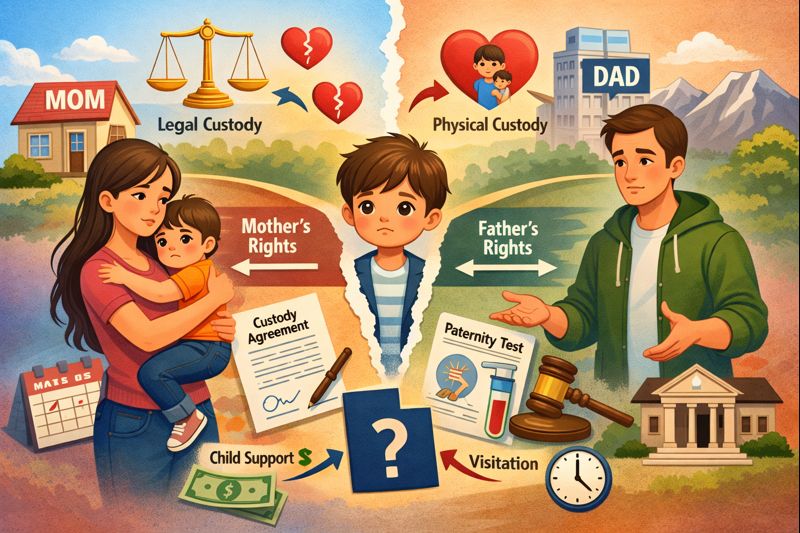
Custody cases move more smoothly when everyone is using the same terms. Utah law separates decision-making authority from where a child lives, and it treats parent-time as its own topic.
| Term | What it means in a Utah custody case |
|---|---|
| Legal custody | Who has authority to make major decisions for a child, such as education and medical care. Legal custody may be joint or sole. |
| Physical custody | Where the child lives and the day-to-day schedule. Physical custody can be shared in different ways, depending on the facts and the court order. |
| Parent time | The schedule for a child’s time with each parent. Utah statutes provide minimum parent-time standards in many situations, and a court can order a schedule that fits a child’s best interests. |
| Parentage and paternity | The legal relationship between a parent and a child. For unmarried parents, establishing legal fatherhood is often required before a father can seek enforceable custody or parent-time orders. |
Custody decisions are guided by Utah statutes that focus on a child’s best interests. Many cases also turn on whether joint legal custody is workable, and whether each parent can support stable, low-conflict co-parenting.
Best interests of the child: Utah courts must order what is in a child’s best interests when making custody and parent-time decisions.
No gender preference: Utah law does not give a custody preference to a parent due to gender.
Parent-time standards: If parents cannot agree, Utah law includes minimum parent-time schedules that may apply depending on a child’s age and the situation.
If you are building a schedule, it helps to review Utah parent-time schedules and minimum standards and how parenting plans in Utah are built.
The video below covers how custody is determined in Utah generally, which is useful context once parentage is clear and the court is deciding legal and physical custody.
Watch: How Is Child Custody Determined in Utah
Typical Court Procedures for Unmarried Parent Custody Cases
Every case is different, but most custody matters follow a predictable path. The main goal is to get enforceable orders that protect a child’s stability and reduce future conflict.
Step 1: Confirm parentage early
If legal fatherhood is disputed or not established, this may need to be resolved first so the court can enter enforceable custody and parent-time orders.
Step 2: File the right case and request custody orders
A custody case can ask the court to set legal custody, physical custody, parent-time, and related issues. Court deadlines and required steps apply once the case is filed.
Step 3: Exchange required information and stay organized
Custody disputes often turn on credible facts. Parents who keep records, stay calm, and present child-focused proposals are usually in a stronger position.
Step 4: Negotiate, mediate, or proceed to a court decision
Many cases settle with a parenting plan. If parents cannot agree, the court decides custody and parent-time using the best-interests standard.
If your case also involves child support questions, you may want to read Utah child support calculations explained and how to modify child support in Utah.
Required Forms and Filings That May Come Up
The exact paperwork depends on your facts and what is disputed. In many situations, unmarried parents will deal with parentage paperwork, custody filings, and a parenting plan or parent-time proposal.
Voluntary Declaration of Paternity: Unmarried parents may be able to sign and file a declaration of paternity through the appropriate Utah process so a father is recognized legally.
Administrative paternity process: In some circumstances, an administrative order may address paternity through the Office of Recovery Services process.
Court custody order: A court case can address parentage and request orders for legal custody, physical custody, and parent-time.
Parenting plan details: A workable plan usually covers decision-making, schedules, holidays, transportation, communication, and conflict-resolution expectations.
Guided forms: Utah Courts provide guided tools for certain family cases through MyPaperwork and related self-help resources.
If you anticipate disagreement about custody or parent-time, it also helps to understand how courts enforce orders. See enforcing custody and visitation orders in Utah.
This Instagram reel focuses on communication habits that can help co-parents reduce misunderstandings and create a stronger paper trail when it matters.
Common Mistakes to Avoid
Unmarried parents often want to move quickly to a schedule. That makes sense, but skipping legal steps or relying on informal agreements can create bigger problems later.
Assuming parentage is automatic: If legal fatherhood is not established, a father may need to complete the correct legal process before enforceable custody or parent-time orders can be entered.
Relying on verbal agreements: Informal schedule agreements can fall apart quickly, and they are hard to enforce without a court order.
Building a plan around adult conflict: Utah courts focus on a child’s best interests. Proposals that show stability, safety, and cooperation usually land better than blame-focused arguments.
Ignoring deadlines and required steps: Missing court requirements can delay progress and increase the cost and stress of the case.
This Instagram reel is a helpful reminder that custody cases are not about fitting a stereotype. Courts look at real parenting behavior, consistency, and a child-focused plan.
The video below provides general context about custody rights for children born outside marriage. Because it is not Utah-specific, it should be treated as background only, not a replacement for Utah court rules and Utah statutes.
Watch: General Context on Custody for Children Born Out of Wedlock
Next Steps for Unmarried Parents Seeking Custody Orders
If you are trying to set up custody and parent-time in Utah and you were never married to the other parent, the best next move is usually to get organized and address the most important legal question first: parentage.
Gather key documents, including birth records, any signed parentage paperwork, school and medical records, and a timeline of who has been providing day-to-day care.
Draft a child-focused proposed schedule that matches school, work, transportation, and the child’s developmental needs.
Think through decision-making topics in advance, including healthcare, education, extracurricular activities, travel, and communication expectations.
If you anticipate future changes, learn the basics of Utah child custody modifications and how to file so you understand what it takes to adjust an order later.
Talk to Gibb Law Firm About Child Custody for Unmarried Parents in Utah
Gibb Law Firm is a Utah-based firm focused on clear, practical guidance in high-stakes family matters. If you are navigating custody questions as an unmarried parent, we can help you understand your options, identify the legal steps that matter most, and pursue a plan that supports your child’s stability and wellbeing.
Schedule a Consultation