When a customer gets hurt at a store, restaurant, office, or event space, the first question is usually simple: what caused the injury? The next questions are tougher. Was there a preventable hazard? Did the business know about it, or should it have? And how do you connect the incident to real medical and financial harm?
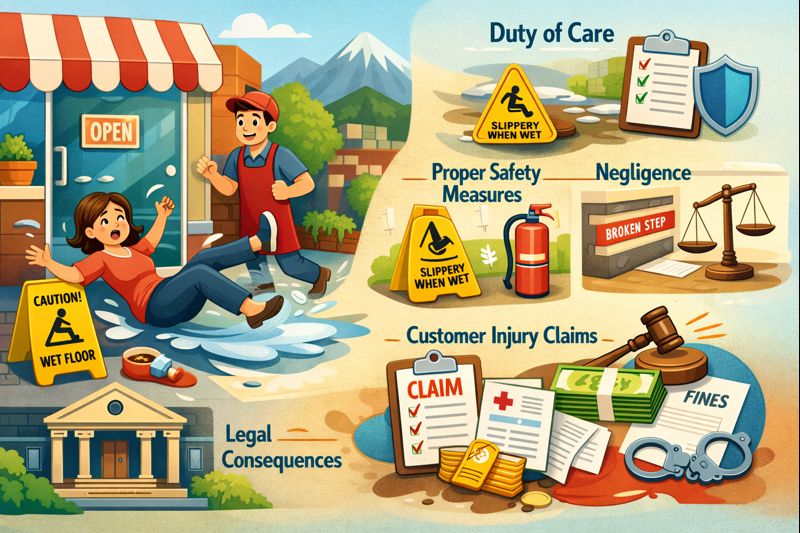
In Utah, many customer injury cases fall under premises liability. These claims often involve slips, trips, falling merchandise, broken stairs, wet floors, uneven pavement, poor lighting, or other unsafe conditions. If you want a fuller overview of how premises cases are evaluated, see understanding premises liability in Utah.
Note: This article is educational information, not legal advice. Outcomes depend on the facts, who controls the property, and how Utah rules apply to your situation.
Overview of Utah Business Liability for Customer Injuries
Most customer injury matters start the same way: an incident occurs, medical care is needed, and an insurance claim follows. The business (or its insurer) may investigate, request statements, and review records like incident reports and surveillance video. If the insurer disputes fault or the value of the claim, the dispute can escalate into formal settlement negotiations or a lawsuit.
Time matters. Conditions can be fixed, spills can be cleaned, and video can be overwritten as part of normal operations. If you may need to prove what happened, early documentation is often the difference between a clear record and a dispute based on guesses. For a practical checklist, see steps to take after a slip and fall in Utah.
What caused the injury: The specific hazard or unsafe condition, plus where it was and how it appeared to a normal customer.
Notice: Whether the business knew about the condition, or whether it existed long enough that reasonable inspections should have found it.
Injuries and losses: Medical records, treatment timelines, and documentation of costs and time missed from work.
Who controlled the area: The responsible party might be the property owner, a tenant, a maintenance vendor, or more than one entity.
The video below provides an overview of premises liability in Utah and how slip, trip, and fall claims are typically evaluated. It is a helpful starting point for understanding when a business may be held responsible for customer injuries.
Watch: Premises Liability in Utah and When a Business May Be Responsible
Even when a claim stays out of court, the process often follows an insurance track with documentation, negotiation, and decision points. Many people benefit from learning the basic flow early so they can stay organized and avoid preventable gaps.
Key Definitions and Utah Statutes
Customer injury claims usually turn on a few core ideas: duty of care, an unreasonably dangerous condition, notice, causation, and damages. Utah also applies comparative negligence rules, which means fault can be shared and can directly change the outcome of a claim. For a plain-English explanation, see how comparative negligence works in Utah injury claims.
Premises liability: A category of claims where an injury is tied to an unsafe condition on property.
Business invitee: A customer or visitor invited onto property for business purposes. These cases typically focus on reasonable care to keep areas safe for expected use.
Notice: Proof the business knew about the hazard or should have known through reasonable inspections and maintenance.
Comparative negligence: Fault can be allocated. If the injured person is found more at fault than the defendants combined, recovery may be barred, and smaller fault percentages can reduce damages.
Deadlines: Utah statutes set time limits for filing. Claims involving government entities can have shorter notice requirements than typical business cases.
The video below explains general premises liability duties. Use it to understand the basic expectation placed on property owners and businesses to address hazards and protect visitors.
Watch: General Premises Liability Duties for Property Owners
Business responsibility can also become more complicated when ownership changes. In some situations, legal concepts like successor liability can affect who may be responsible after a purchase, merger, or rebrand.
Typical Claim Steps and How a Case Moves Forward
Most cases are easier to understand when you think in phases. First comes the incident and medical care. Next comes the insurance investigation. If the claim does not resolve, the final phase is formal litigation, where evidence must meet court rules and deadlines.
Step 1: Get medical care and document symptoms
Medical records often become the backbone of the injury timeline. Early care can also reduce arguments about unrelated causes.
Step 2: Report the incident and confirm it was recorded
Ask whether an incident report was created and note who you spoke with, plus the date and time.
Step 3: Preserve scene proof
Photos and video of the hazard, lighting, signage, and surrounding area help show what a typical customer would have encountered.
Step 4: Identify who controlled the area
A tenant, a landlord, and a maintenance contractor can each have different responsibilities depending on the location and agreement.
Step 5: Insurance investigation and negotiation
Insurers may request statements and records, then evaluate fault and damages before making a decision or offer.
Step 6: Litigation if the claim remains disputed
If a lawsuit is filed, the case typically proceeds through discovery (exchange of evidence), motions, and potentially trial or settlement.
| Phase | What to keep and why it matters |
|---|---|
| Incident and immediate reporting | Incident report details, names of staff, and basic timeline notes that lock in the first account of what happened. |
| Scene documentation | Photos and video of the hazard, warnings, lighting, and surrounding area to show conditions at the time of injury. |
| Medical treatment period | Visit summaries, diagnosis notes, therapy plans, work restrictions, and billing records to prove injuries and costs. |
| Insurance evaluation | Claim numbers, adjuster contacts, written communications, and proof of out-of-pocket expenses and lost income. |
| Litigation and discovery | Requests for surveillance video, maintenance logs, and witness statements to address notice, causation, and fault. |
The Instagram reel below shows a real-world premises liability incident and explains how cases are often investigated and pursued when injuries occur in public-facing settings.
Records, Forms, and Filings That Commonly Matter
There is not always one standard form that applies to every business injury claim, but there are common records that tend to matter in Utah insurance claims and lawsuits. The goal is to request or preserve them early so they do not disappear.
Incident report information: Whether a report was created, who took it, and the basic details recorded at the time.
Surveillance and photo evidence: Request that relevant footage be preserved if cameras may have captured the area. If you need a deeper checklist, see collecting evidence after a slip and fall accident.
Medical and billing documentation: Visit summaries, treatment plans, prescriptions, work restrictions, and invoices.
Loss documentation: Receipts, mileage, assistive devices, and wage loss proof if time away from work is involved.
Special notices for government property: If a fall happened on city, county, or state property, extra notice rules may apply and deadlines can be shorter than typical business cases.
The video below explains slip and fall injuries on city property in Utah. It is useful when the location is not a typical private business space, such as a public sidewalk, public parking area, or a government-owned facility.
Watch: Slip and Fall Injuries on City Property in Utah
Common Mistakes to Avoid
Many cases weaken because the record is incomplete, not because the injury was not real. These are common problems that can often be avoided with simple, early steps.
Not documenting the hazard quickly: Conditions can change fast. Photos and video preserve the scene as it existed.
Leaving without witness details: Neutral witnesses can help confirm what the hazard was and how the incident happened.
Assuming the business owner is the only responsible party: Liability can depend on who controlled maintenance, inspections, and the specific area where the injury happened.
Waiting too long to ask about video: Many systems overwrite footage on a schedule. Early requests can matter.
Missing deadlines: Utah filing limits and special notice rules can bar a claim if they are not followed.
The Instagram reel below shows common retail slip and fall scenarios, like uneven pavement and floor hazards. It is a practical reminder that small conditions can cause serious injuries, and that documentation often matters when fault is disputed.
Explore Related Utah Legal Guides
If you want more Utah-specific guidance on what tends to matter in customer injury and slip and fall cases, these related resources are a solid next step.
Next Steps: A Practical Checklist
If you are trying to stay organized after a customer injury incident, this checklist helps you focus on the items that usually matter most in liability and insurance discussions.
Capture the scene safely: Wide photos, close-ups of the hazard, and a short video walkthrough when possible.
Write a short timeline early: What you saw, where you were walking, what happened, and who helped right after.
Keep medical records together: Visit summaries, diagnoses, treatment plans, work restrictions, and invoices.
Track costs and time lost: Receipts, mileage, assistive devices, and wage loss documentation if applicable.
Preserve key communications: Names, claim numbers, letters, emails, and notes from phone calls.
Talk to Gibb Law Firm About Business Liability and Customer Injury Claims
Gibb Law Firm is a Utah-based law firm focused on clear, practical guidance for people and businesses facing real legal problems. If you are dealing with a customer injury situation and you want help understanding liability, evidence, and next steps, our team can help you evaluate options and build a path forward.
Schedule a Consultation