Utah Slip & Fall Liability Guide
After a slip and fall, the biggest legal question is usually simple: “Who is responsible?” In Utah, proving liability is what turns an injury into a valid premises claim. It is not enough to show you fell. You typically need evidence that a property owner or occupier failed to use reasonable care and that the unsafe condition caused your injuries.
Most slip and fall cases start as insurance claims, not lawsuits. Adjusters often make early decisions based on photos, incident reports, witness statements, and medical records. If the evidence is incomplete, it is common for an insurer to argue the hazard was not their fault, was not there long enough to fix, or that the injured person was partly responsible.
For related Utah injury and insurance context already published on the site, you can read what to do after a car accident in Utah and understanding Utah’s no-fault insurance rules. While those topics are car-accident focused, they can still help you understand how documentation and insurance decisions often work in Utah injury claims.
Note: This article is educational information, not legal advice. Utah deadlines and notice requirements can be strict, and the right approach depends on the facts, the property type, and the available evidence.
Proving Liability in a Utah Slip and Fall Case
In plain English, a slip and fall case is about negligence. You are trying to show that someone responsible for the property did not act reasonably to keep the area safe, and that failure caused your injuries. In many cases, the hardest part is not proving you were hurt. It is proving what created the hazard, how long it was there, and what the property owner knew or should have known.
Hazard plus responsibility: You usually need proof of a dangerous condition (like a spill, ice, or broken flooring) and proof that the property owner or occupier should be legally responsible for it.
Notice is a frequent battleground: Many disputes come down to whether the owner had actual notice (they knew) or constructive notice (they should have known through reasonable inspection).
Comparative fault can reduce recovery: Utah allows fault to be shared. If you are assigned a percentage of fault, that can reduce damages and, in some situations, can limit recovery.
Insurance is often first: Most cases are evaluated through an insurance claim before any lawsuit is filed, so early documentation matters.
The video below discusses practical slip and fall tips, including why recorded statements to insurance adjusters can create problems if you are not prepared and the facts are still developing.
Watch: Slip and Fall Tips and Recorded Statement Caution
Key Definitions and Utah Laws That Shape Slip and Fall Liability
Slip and fall claims usually follow the same core negligence framework used in many injury cases. That means focusing on duty, breach, causation, and damages. Utah’s comparative fault rules can also matter, because property owners and insurers often argue that a person should have seen the hazard or acted more carefully.
Duty of care: The responsibility to use reasonable care in maintaining a property and addressing unsafe conditions in areas where visitors are expected to be.
Breach: A failure to act reasonably, such as not cleaning a spill, not treating icy walkways, not fixing broken flooring, or not providing adequate warnings when a hazard exists.
Causation: Proof that the specific hazard caused the fall and the injuries, not a separate medical issue or an unrelated event.
Damages: The losses connected to the fall, including medical costs, missed work, and other harms supported by records.
Comparative negligence statute: Utah’s comparative negligence framework is addressed in Utah Code Section 78B-5-818.
Definition of fault: Utah’s statutory definition of “fault” is addressed in Utah Code Section 78B-5-817.
Claims involving city or government property: Notice deadlines for claims against a governmental entity are addressed in Utah Code Section 63G-7-402.
The reel below highlights a real-world truth about premises cases: they are often evidence-driven. Photos, incident reports, and other documentation can make or break liability arguments.
Typical Claim Steps and How Liability Gets Evaluated
Most slip and fall cases follow a practical sequence. First comes documentation and medical care. Next comes an insurance claim and investigation. If the case cannot be resolved, a lawsuit may follow. Even then, most cases still resolve through negotiation or mediation once the key evidence is exchanged.
Step 1: Report the fall and ask for an incident report
Reporting creates an early record of where and when the fall happened, who was notified, and what was observed at the scene.
Step 2: Photograph the hazard and surroundings
Take photos or video of the floor surface, lighting, signage, footwear, weather conditions, and the specific area where you fell.
Step 3: Identify witnesses and preserve contact info
Neutral witness statements can support the condition of the area, whether warnings existed, and how the fall occurred.
Step 4: Get medical care and keep records
Medical documentation helps connect the fall to injuries and addresses the common argument that injuries were preexisting or unrelated.
Step 5: Insurance investigation, negotiation, and possible litigation
Insurers may request records, statements, and documentation. If liability is disputed, the case may move toward formal discovery and expert review.
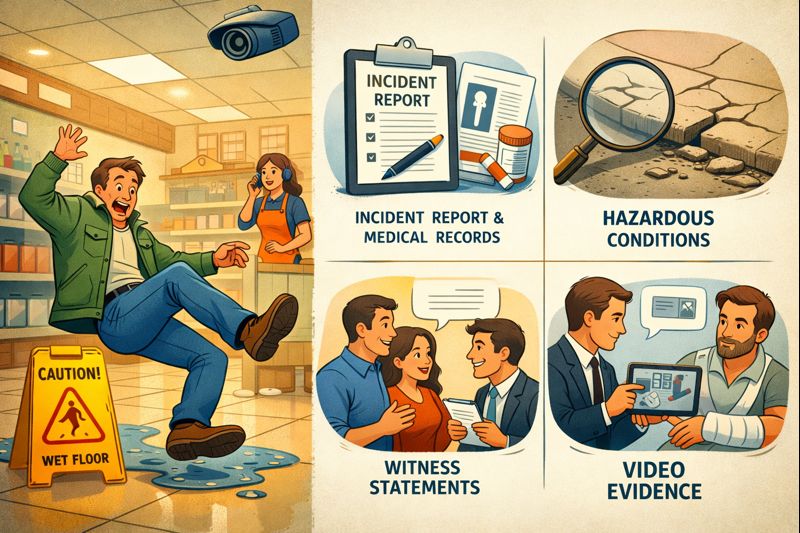
| Evidence source | What it helps prove in a slip and fall |
|---|---|
| Photos and video of the hazard | Shows what made the area dangerous and whether warnings were present at the time of the fall. |
| Incident report and property records | Documents that the fall was reported and may identify employees, managers, or maintenance activity. |
| Witness statements | Supports what the area looked like, how the fall happened, and whether staff knew about the condition. |
| Surveillance footage | Can show how long a hazard existed, whether people slipped earlier, and how the fall occurred. |
| Medical records and timelines | Supports causation and damages by linking the fall to specific injuries and treatment needs. |
The reel below emphasizes the type of proof that often matters most: witness testimony, security footage, and documentation that supports how the hazard existed and why the owner should be responsible.
The video below focuses on city property scenarios. Falls on sidewalks, public buildings, or other government-maintained areas can involve additional notice and timing requirements, so it is important to treat those cases differently from a private business claim.
Watch: Slip and Fall on City Property and Liability Considerations
If you want another Utah example of how fault questions can change a claim outcome, see how fault is determined in Utah car crashes. Slip and fall cases are different from auto cases, but the comparative fault concept and evidence-first approach are similar.
Records, Forms, and Documentation That Often Matter
There is no single “slip and fall form” that proves a case. What matters is building a clean record that shows the hazard, the owner’s notice or responsibility, and the medical and financial impact. In some cases, formal filings become necessary, especially if the claim is against a government entity or if the insurer refuses to accept liability.
Incident report: Ask for confirmation that a report was made, and note the name and title of the person who took it.
Scene documentation: Photos of the hazard, footwear, lighting, signage, and any wet floor cones or warning placards.
Medical documentation: Urgent care or ER records, follow-up treatment records, imaging, and therapy records.
Wage and expense proof: Pay stubs, employer confirmation of missed work, and receipts for out-of-pocket expenses.
Government claim notices when applicable: If the fall involves a governmental entity, notice deadlines can apply under Utah Code Section 63G-7-402.
The reel below highlights why reporting and documentation matter after a fall, especially when injuries are not immediately obvious and symptoms develop over time.
For a practical checklist style overview of early documentation steps in a Utah injury situation, this published page can be helpful: what to do after a car accident in Utah. The same habits often apply after a fall, like documenting the scene, preserving evidence, and keeping records.
Common Mistakes That Can Undercut Liability
Slip and fall cases can become difficult when evidence is missing. Many hazards are temporary. Spills get cleaned, ice melts, cones move, and surveillance footage can be overwritten. A few early mistakes can make it harder to prove notice, causation, or the severity of injuries.
Not documenting the hazard right away: If the condition changes, you may lose the best proof of what caused the fall.
Leaving without reporting: A missing incident report can make it easier to dispute whether the fall happened as described.
Waiting too long for medical care: Delays often lead to causation arguments and reduce clarity in medical timelines.
Giving a recorded statement too early: If you are still learning the facts or your symptoms are evolving, careless phrasing can be used against you later.
Not preserving witness information: Witnesses can be hard to locate later, and their observations can be key to notice and credibility.
The video below covers premises liability causation in a slip and fall context. This is often where claims are challenged, even when the hazard seems obvious.
Watch: Proving Causation in a Slip and Fall Claim
Next Steps if You Need to Prove Liability
If you believe a property owner should be responsible for your fall, it helps to take a structured approach. The goal is to preserve evidence, reduce gaps in the timeline, and keep the claim organized from the beginning.
Preserve what you can immediately: Photos, video, shoes worn, and the names of employees or managers involved.
Write a simple timeline: Note the date, time, exact location, weather (if relevant), and what you noticed before and after the fall.
Track symptoms and treatment: Keep appointment dates and a basic log of limitations, which can support injury causation.
Be careful about statements: It is fine to cooperate, but avoid guessing or agreeing to conclusions about fault before the evidence is gathered.
Talk to Gibb Law About a Utah Slip and Fall Liability Claim
Gibb Law is a Utah-based firm focused on clear, practical guidance for clients facing real-world legal problems. If you were injured in a slip and fall and liability is disputed, we can help you understand what proof matters, how comparative fault may apply, and what next steps fit your situation.
Schedule a Consultation