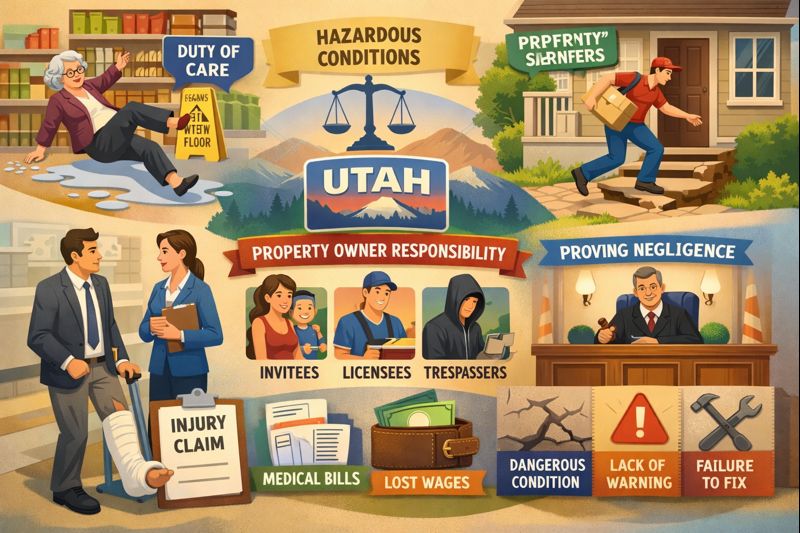
Premises liability is the area of Utah law that covers injuries caused by unsafe property conditions. Many Utah slip and fall cases fall under this umbrella, but premises liability can also include trip hazards, falling merchandise, poor lighting, uneven pavement, and other conditions that create a foreseeable risk of harm.
In plain English, the core question is usually this: Should the person or entity in control of the property have fixed the hazard or warned about it, and did a failure to do so contribute to an injury?
If you are unsure what to do right away after an injury event, this step-by-step guide can help you think through documentation and next steps: what to do after a car accident in Utah. While that article is written for auto crashes, many of the same evidence and claim steps apply in premises liability cases too.
For the insurance side, it can also help to understand how insurers evaluate claims and what to expect in early communications: dealing with insurance adjusters in Utah.
Timelines are another common concern. This overview explains how claim timelines are commonly discussed and why acting early matters: Utah car accident claim timelines explained.
When the injury is serious or liability is disputed, many people want to know when it makes sense to speak with a lawyer. This guide discusses that decision point: when to hire a Utah car accident attorney.
If you want a visual reference image to place near the top of this article, you can use: premises liability image reference.
Note: This article is educational information, not legal advice. Court procedures and deadlines can vary by case type, county, and the specific facts involved.
Overview of Premises Liability Claims in Utah
Most premises liability claims start as insurance claims. A store, property owner, or management company may have coverage that addresses injuries on the premises. Some cases resolve through documentation and negotiation. Others require a lawsuit when liability is disputed, evidence is missing, or the injury and damages are significant.
Control matters: Liability often turns on who controlled the area where the injury happened. That can be an owner, tenant, property manager, contractor, or a combination of parties.
Reasonableness matters: These cases typically focus on whether the hazard was foreseeable and whether reasonable inspection, maintenance, repair, or warning steps were taken.
Evidence matters early: Photos, incident reports, witness names, and prompt medical documentation can make a major difference, especially when surveillance footage is time-limited.
Fault can be shared: Utah applies comparative negligence principles, which can reduce or limit recovery depending on how fault is allocated.
The video below explains how slip and fall incidents are commonly analyzed as premises liability cases in Utah, including defenses that come up in real-world claims.
Watch: Slip and Falls as Premises Liability Cases in Utah
Key Definitions and Utah Law Basics
Premises liability is not one single “premises liability statute.” Instead, these cases are usually built on negligence principles and Utah-specific rules about duties, defenses, and special claim procedures.
Visitor status: Utah cases commonly discuss duties based on whether a person is an invitee, licensee, or trespasser. The label often depends on why the person was on the property and whether the visit benefited the property possessor.
Open and obvious hazards: A common defense is that a hazard was visible and should have been avoided. Whether that defense applies can depend on the facts and how fault is allocated.
Comparative negligence: Utah’s comparative negligence rules can reduce a claim if the injured person is found partially at fault. In some cases, fault allocation can also limit recovery entirely.
Government property claims: If the injury involves a city sidewalk, public building, or other governmental entity, Utah law can require a written notice of claim before maintaining an action, and deadlines can apply earlier than people expect.
When people ask what makes a “strong” slip and fall claim, they are usually asking about proof: what shows the hazard existed, how long it existed, and whether the property should have addressed it. The Instagram reel below highlights the kind of evidence that is commonly discussed in premises liability cases.
To understand how claims are commonly evaluated and negotiated, you can also review dealing with insurance adjusters in Utah, since adjuster questions and documentation requests often follow similar patterns across injury claims.
Typical Claim Steps and Court Procedures
Many premises liability matters follow a similar pattern, whether they resolve through insurance or move into litigation. The key is staying organized and focusing on facts that can be verified.
Step 1: Get medical care and document the injury
Health comes first. Early medical documentation also helps connect the injury to the incident and reduces later disputes about timing and causation.
Step 2: Report the incident and preserve evidence
If possible, request an incident report and keep a copy. Take photos of the area, the hazard, footwear, and visible injuries, and collect witness names and contact details.
Step 3: Identify who controlled the area
Control may involve more than one party, such as an owner plus a tenant or a contractor. Identifying the right party early helps avoid delays.
Step 4: Insurance claim, investigation, and negotiation
Many cases involve an insurer review, a request for records, and a negotiation phase. This is where clarity and consistent documentation matter.
Step 5: Lawsuit, discovery, and resolution steps
If settlement is not possible, a case may proceed to a lawsuit. Many cases then move through written discovery, document exchange, depositions, motion practice, and often settlement discussions.
| Where the injury happened | What often becomes the key question |
|---|---|
| Retail store or business | Whether the hazard was foreseeable and whether reasonable inspection, cleanup, repair, or warning steps were taken. |
| Apartment or rental property | Whether an owner, landlord, property manager, or contractor had notice of the condition and had the ability to address it. |
| Private home | Whether the homeowner knew or should have known of the hazard, and what duty applies based on the visitor’s status. |
| City or public property | Whether the claim triggers Utah governmental notice requirements, and whether the issue relates to maintenance, design, or other immunities and exceptions. |
Retail cases are common because floors, entry mats, spills, and weather-related conditions can change quickly. The Instagram reel below discusses slip and fall risk at major retail stores and why documentation matters.
Required Forms or Filings and Utah-Specific Deadlines
The paperwork depends on who the claim is against and how the case proceeds. Many claims start informally with an incident report and an insurance claim. If the case escalates, formal filings may be required.
Incident report and records request: Businesses often complete an internal report. You may also request copies of reports, photographs, or relevant surveillance footage if it exists.
Medical documentation: Treatment records, imaging, and receipts help document the injury and damages.
Insurance claim communications: Keep copies of letters, emails, claim numbers, and any statements you provide. If you are asked for a recorded statement, it is smart to understand the purpose and scope first.
Government notice of claim: If the injury involves a governmental entity (such as a city, county, school district, or the state), Utah law generally requires a written notice of claim before maintaining an action, and deadlines can apply. This is one reason public-property injuries often benefit from early legal review.
Government-property cases are often misunderstood because they can have extra steps and earlier deadlines. The video below discusses rights and options after a slip and fall on city or public property in Utah.
Watch: Slip and Fall Injuries on City or Public Property in Utah
Premises liability can involve more than a wet floor. Uneven pavement, broken steps, poor lighting, or unsafe walkways can also lead to injuries. The Instagram reel below gives examples of unsafe property conditions that can lead to premises liability discussions.
Common Mistakes to Avoid
Premises cases often rise or fall on early documentation. Many disputes are not about whether a person was injured. They are about what caused it, who controlled the hazard, and what could have been done reasonably to prevent it.
Waiting too long to document the scene: Conditions change quickly. Photos and witness information are easiest to collect right away.
Not identifying the right responsible party: Ownership and control can be split between an owner, tenant, manager, or contractor. Misidentifying the party can cause delays.
Overlooking public-property notice requirements: Claims involving a city, county, or state may require a formal notice of claim and can have shorter timelines than people expect.
Giving inconsistent statements: If you provide a timeline, stick to facts you know. Estimates and guesses can create credibility problems later.
Ignoring the claim timeline: Waiting too long can make it harder to get records, witness names, and video. For a general sense of why timelines matter in injury claims, see Utah car accident claim timelines explained.
Next Steps After a Potential Premises Liability Injury
If you suspect your injury may involve premises liability, the goal is to protect your health and preserve clear, factual evidence. A simple checklist can help you stay focused.
Write down the basics: Date, time, exact location, what you were doing, what you saw, and what happened. Keep it accurate and simple.
Gather key proof: Photos, witness details, your shoes, and any incident report confirmation are common starting points.
Track expenses and impacts: Medical bills, missed work, limitations, and follow-up treatment plans help document damages in a verifiable way.
Expect insurer follow-up: Many claims involve adjuster questions and documentation requests. If you want a preview of what that can look like, review dealing with insurance adjusters in Utah.
The video below provides a practical overview of indicators that it may be time to talk with a premises liability lawyer after an injury, including common causes of claims and when documentation becomes urgent.
Watch: When to Contact a Premises Liability Lawyer After an Injury
Talk to Gibb Law Firm About Premises Liability in Utah
Gibb Law Firm is a Utah-based law firm focused on clear, practical guidance. If you were injured due to an unsafe property condition, we can help you understand the process, identify the responsible party, and evaluate next steps under Utah law.
Schedule a Consultation