What Evidence Is Needed in Utah Small Claims Cases
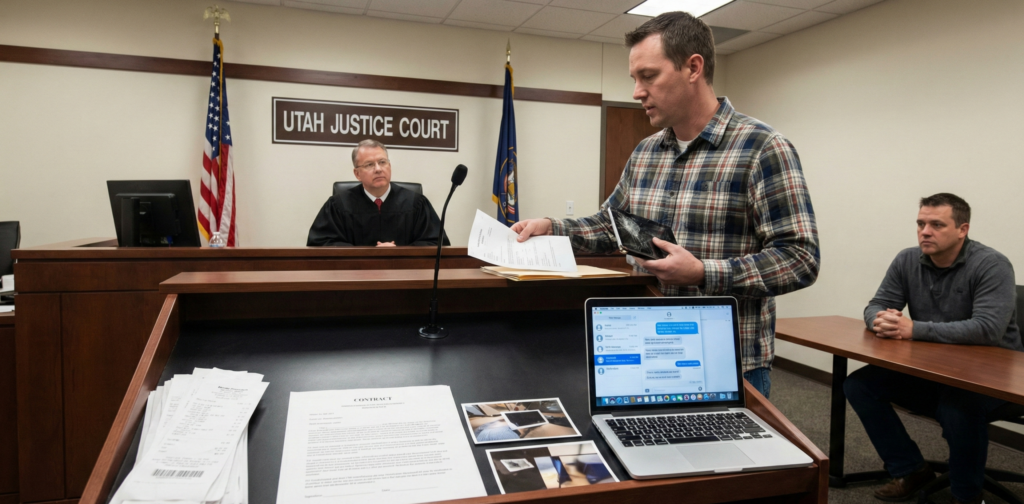
What evidence is needed in Utah small claims cases: Most small claims cases are won or lost on proof. Judges usually expect you to show clear records that explain what happened, how much money is owed, and why the other side is responsible.
This plain-English guide explains the types of evidence that commonly matter in Utah small claims cases, how evidence is typically presented, and how to avoid common proof mistakes that can weaken an otherwise valid claim.
Note: This article is for educational purposes and is not legal advice. Every case is different, and court rules, deadlines, and available evidence can affect outcomes.
What Evidence Is Needed in Utah Small Claims Cases
Utah small claims court is designed to be simpler than other civil cases, but the core requirement is the same: you still have to prove your claim. In most cases, that means you need evidence that answers three questions clearly.
What happened: A timeline of events and what agreement or obligation existed.
Why the other party is responsible: Proof showing breach, nonpayment, damage, or another legal basis.
How much you are owed: Documentation showing the amount and how you calculated it.
Small claims cases often involve unpaid debts, security deposits, damaged property, incomplete work, or disagreements over services. No matter the topic, the judge generally relies on the evidence you bring, not assumptions or verbal promises.
If you are deciding whether your dispute belongs in small claims, start with our Utah small claims and debt collection guide. If you are pursuing payment after judgment, our Utah contract dispute litigation guide can also provide helpful background on contract proof and documentation.
The video below offers a practical, plain-English overview of what people commonly bring to small claims court to support their side of the story.
Watch: What Evidence to Gather for Small Claims Court
Key Definitions and Utah Statutes
Utah small claims cases are handled in Utah Justice Court. While the process is streamlined, the court still expects reliable proof and a clear explanation of why you should win.
Plaintiff: The person or business filing the small claims case.
Defendant: The person or business being sued.
Evidence: Information used to prove facts. In small claims, this is often documents, photos, and witness testimony.
Burden of proof: The responsibility to prove your claim. In small claims, you generally need enough credible evidence to persuade the judge.
Judgment: The court’s final decision, including whether money is owed and how much.
In everyday terms, the court is looking for reliable, organized proof that supports your version of events. If your evidence is unclear, incomplete, or inconsistent, the judge may not be able to award the money you are asking for, even if you feel you are right.

Common Types of Evidence That Usually Matter
In most Utah small claims cases, the strongest evidence is simple, direct, and easy to verify. The table below shows common types of proof and what they usually help establish.
| Type of evidence | Examples | What it helps prove |
|---|---|---|
| Written agreements | Contracts, estimates, invoices, signed proposals | What was promised, price, scope, and deadlines |
| Payment records | Receipts, bank statements, canceled checks, payment app screenshots | What was paid, what is still owed, and when |
| Messages and communications | Email, text messages, letters, chat logs | Admissions, notice of problems, attempts to resolve |
| Photos and videos | Property damage images, work quality photos, timestamped videos | Condition before and after, extent of damage, incomplete work |
| Witnesses | Someone who saw the event, inspected the work, or heard key statements | Credible support for disputed facts |
| Physical items | Damaged item, defective product, returned parts | Direct proof of damage or defect (when practical to bring) |
The video below reviews the most common categories of evidence used in small claims cases, including documents, photos, witnesses, and physical items.
Watch: Types of Evidence Allowed in Small Claims Court
Typical Court Procedures or Claim Steps
Small claims is meant to be approachable, but it still follows a process. Staying organized from the start helps you present the best version of your case.
Organize your proof and your timeline
Put key documents in date order and write a simple timeline. The goal is to explain what happened in a way that is easy to follow.
File and serve your small claims case
After filing, the defendant must be properly served. If service is incomplete, your case can be delayed or dismissed.
Prepare your evidence for the hearing
Bring copies of your key exhibits. Make sure photos are clear, messages are readable, and totals are supported by records.
Present your case clearly
Judges often have limited time per case. A short, organized explanation tied directly to your evidence is usually more persuasive than a long story.
Receive a judgment and plan next steps
If you win, you may still need to take collection steps. If you lose, you may have limited options depending on the case posture.
The Instagram reel below is a quick reminder that small claims court is often about money disputes, and proof is what makes your position credible.
The video below discusses how evidence is exchanged and submitted in small claims cases in a general U.S. setting. Utah courts have their own local procedures, but the main takeaway still applies: plan ahead so your evidence is readable, complete, and ready when the judge needs it.
Watch: Exchanging and Submitting Evidence in Small Claims Court
Required Forms or Filings and What to Bring
The exact forms and requirements can depend on the court and the dispute type. In general, most people benefit from bringing proof that covers the agreement, the problem, and the amount requested.
Your filed documents: A copy of what you submitted to start the case and any related court paperwork you received.
Proof of the deal or obligation: Contract, estimate, invoice, lease clause, or any written terms that show what was agreed.
Proof of payment and balance: Receipts, bank records, and a simple total showing how you calculated the amount you are asking for.
Proof of the issue: Photos, inspection notes, repair estimates, return records, or written complaints that show what went wrong.
Proof you tried to resolve it: Emails or texts showing notice, requests for payment, and reasonable attempts to fix the problem.
If your dispute involves contract performance or unpaid invoices, you may also want to review our Utah contract dispute litigation guide to understand what types of proof often matter in contract-related cases. If your case becomes more complex, our Utah discovery, evidence, and motions practice guide explains how evidence handling differs in larger civil cases.
The Instagram reel below highlights a simple but consistent small claims lesson: keep receipts and document everything from the start.
Common Mistakes to Avoid
Many small claims cases fall apart because the evidence is missing, disorganized, or hard to follow. These are common proof issues that can weaken a claim.
Relying only on verbal statements: If it is not written down or supported by records, it can be hard to prove.
Bringing screenshots that are unclear: Make sure messages show names, dates, and full context, and print them so they are readable.
Not proving the amount requested: Judges usually want receipts, invoices, or calculations supported by records, not estimates without documentation.
Skipping a clean timeline: A short timeline tied to your documents often makes your case easier to understand.
Forgetting about service or court instructions: Missing procedural steps can delay your hearing or lead to dismissal.
The Instagram reel below touches on whether you should represent yourself in small claims court. Even when you do, preparation and proof are usually the deciding factor.
Next Steps
If you are planning for a Utah small claims hearing, a few practical steps can make your case easier to present and easier for the judge to evaluate.
Build a short evidence packet
Put your strongest documents first, then add supporting items in date order so the story makes sense quickly.
Print clear copies
Bring readable printouts of contracts, messages, photos, and receipts. If a document is hard to read, it is harder to rely on.
Keep damages simple
Show exactly how you calculated the amount requested, and match the number to your receipts or invoices.
Know when the case is bigger than small claims
If your dispute involves complex evidence, multiple parties, or high dollar amounts, legal guidance may help you choose the right path.
Talk With Gibb Law About a Utah Small Claims Dispute
Gibb Law is a Utah-based firm focused on clear, practical guidance. If you are preparing for a small claims case and want help understanding what evidence matters, how to organize your proof, and what next steps may make sense for your situation, we can review your options and explain the process in plain English.
Schedule a Consultation