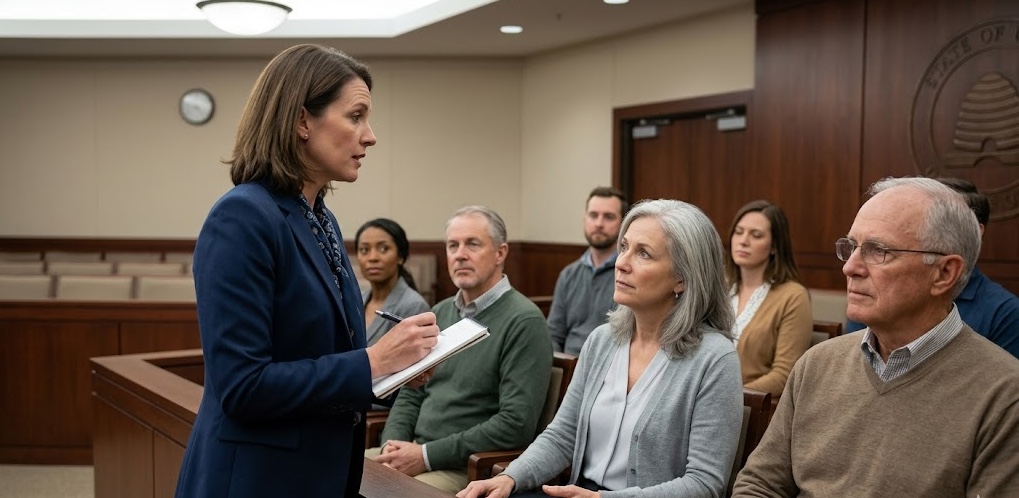
Selecting a Jury in Utah Civil Trials
Why this matters: Selecting a jury in Utah civil trials can shape the outcome of a case before opening statements even begin. Jury selection affects how fairly the evidence is heard, whether hidden bias is identified, and whether the final panel can decide the dispute based on the law and the facts presented in court.
In Utah civil litigation, jury selection usually includes assembling a panel of potential jurors, questioning them during voir dire, evaluating bias or hardship, making challenges for cause when appropriate, and using limited peremptory challenges to help shape the final jury under Utah law and court procedure.
Note: This article is for educational purposes only and is not legal advice. Jury selection in a Utah civil case depends on the court, the type of claims involved, pretrial rulings, local courtroom practices, and the specific facts that may affect juror impartiality.
Selecting a Jury in Utah Civil Trials
If you are searching for Utah trial, selecting a jury in Utah civil trials, or practical guidance under Utah law, you are probably trying to understand one of the most important stages of a civil case. Jury selection is where the court and the parties work to identify a fair and impartial group of jurors who can decide the case based on the evidence rather than personal bias, outside information, or preconceived views.
In many civil cases, the jury will be the group that hears testimony, reviews exhibits, evaluates credibility, and returns a verdict. That makes the selection process especially important. A well-conducted voir dire can reveal concerns about fairness, help the judge rule on whether a potential juror should be excused, and give both sides a better sense of how the case may be heard in the courtroom.
Under Utah law, civil jury selection is governed by procedural rules, courtroom management decisions, and the practical realities of each case. Some matters may require more detailed questioning than others. A business dispute, personal injury claim, probate contest, or contract case may raise different experiences, assumptions, or biases that lawyers and the court need to explore during the screening process.
For related guidance, see our Utah trial preparation and appeals guide, Utah discovery, evidence and motions practice guide, Utah contract dispute litigation guide, and Utah civil litigation guides.
Overview of Selecting a Jury in a Utah Civil Trial
Jury selection in a Utah civil trial usually begins after the case has moved through pleadings, discovery, and pretrial preparation. By this stage, the parties should know the legal issues that will be presented and the kinds of concerns that may affect juror neutrality. The purpose of selection is not to find jurors who already agree with one side. The purpose is to identify people who can listen fairly, follow the judge’s instructions, and decide the case on the evidence.
The process often starts with a panel of potential jurors being called into court. The judge may give introductory instructions, explain the nature of the case, and ask general questions. Lawyers may then be allowed to ask follow-up questions during voir dire. Those questions are designed to uncover potential conflicts, strong beliefs, prior experiences, or hardships that could affect the juror’s ability to serve impartially.
It protects fairness
Jury selection helps the court identify jurors who can decide the case based on evidence and law rather than outside bias or assumptions.
It reveals possible bias
Voir dire gives the judge and lawyers a chance to learn whether a potential juror has experiences or views that may affect impartiality.
It shapes the trial
The final jury will evaluate witnesses, documents, and arguments, so the selection stage can have a lasting impact on the entire civil trial.
It follows court procedure
Challenges for cause, peremptory challenges, and panel management all take place within the structure of Utah court rules and the judge’s direction.

In practical terms, jury selection is about reducing risk and strengthening trust in the process. The better the court and the parties understand who is being asked to serve, the more likely the case will be heard by a panel that can evaluate it fairly and responsibly.
Key Definitions and Utah Jury Selection Concepts
Before looking at the typical jury selection process, it helps to understand several terms that regularly appear in Utah civil trials. Voir dire is the questioning process used to screen prospective jurors. A challenge for cause is a request to excuse a juror because that person cannot be fair, impartial, or legally qualified to serve. A peremptory challenge allows a party to excuse a juror without giving the same kind of explanation required for cause, subject to constitutional limits that prohibit discrimination. The jury panel refers to the group of potential jurors from which the final jury will be chosen.
Another useful concept is the difference between a juror having a life experience and a juror being unable to set that experience aside. Many prospective jurors will have opinions, jobs, family histories, or prior exposure to legal disputes. The key question is whether those experiences prevent them from deciding the specific case fairly under the judge’s instructions.
Voir dire: The question-and-answer process used to assess whether potential jurors can be fair and impartial in a particular case.
Challenge for cause: A request to remove a prospective juror because of bias, hardship, disqualification, or another reason recognized by law.
Peremptory challenge: A limited strike that may be used to remove a prospective juror without proving specific cause, so long as it is not used in an unlawful discriminatory way.
Impartial jury: A jury made up of people who can listen to the evidence, follow the law, and decide the case without favoritism or prejudice.
These definitions matter because civil jury selection in Utah is not just a formality. It is a structured legal process aimed at building a fair decision-making body before the trial testimony begins.
Typical Steps in Selecting a Jury in Utah Civil Trials
Although each case is different, civil jury selection in Utah often follows a recognizable sequence. The judge controls the courtroom, the prospective jurors are sworn and questioned, the parties raise concerns about bias or qualification, and the final jury is seated after any approved strikes are completed.
Potential jurors are called and introduced to the case
The court brings in a panel, explains the nature of the civil dispute, and begins the process of determining who may be able to serve.
General and case-specific questions are asked during voir dire
The judge and sometimes the lawyers ask questions about background, experiences, relationships, prior jury service, and views that may affect fairness.
Bias hardship and legal qualification issues are examined
The court may consider whether a juror has a conflict, a strong preexisting view, or a hardship that makes service impractical or unfair.
Challenges for cause are raised when appropriate
If a juror cannot be impartial or otherwise should not serve, a party may ask the court to excuse that juror for cause.
Peremptory challenges may be exercised
After the court rules on cause challenges, each side may have a limited number of strikes to remove certain jurors without stating cause in the same way.
The final jury is seated and trial begins
Once the required number of jurors is selected, the panel is sworn and the civil trial moves into opening statements and evidence presentation.
Watch: Jury Service in Utah
This video fits here because it provides an official overview of how jury service works in Utah courts, including what prospective jurors can expect during the selection process and while serving in trial.
What the Court and Lawyers Often Look For During Voir Dire
Voir dire is not only about removing clearly biased jurors. It is also about learning whether prospective jurors can be open-minded, attentive, and able to follow the judge’s instructions. In civil cases, lawyers may ask about experiences with lawsuits, insurance claims, business disputes, contracts, injuries, medical treatment, family conflicts, or other issues that resemble the subject of the case.
| Jury selection issue | What usually happens | Why it matters |
|---|---|---|
| Prior experiences | Jurors may be asked about past lawsuits, injuries, business conflicts, or court experiences | Those experiences may shape how they react to the evidence and arguments |
| Relationships or conflicts | The court may ask whether jurors know the parties, lawyers, witnesses, or insurers involved | Connections to the people or issues in the case can affect neutrality |
| Attitudes and beliefs | Questions may explore views about money damages, lawsuits, credibility, or the role of juries | Strong beliefs may reveal whether a juror can fairly apply the law |
| Ability to serve | Jurors may discuss scheduling, language, health, childcare, or other practical concerns | Hardship issues may affect whether the juror can serve effectively through trial |
| Ability to follow instructions | The judge may ask whether jurors can set aside outside views and decide the case only on evidence | This is central to seating a fair and legally qualified jury |
| Sensitive case themes | Lawyers may ask focused questions about topics that could create hidden bias in the case | Focused questioning can uncover concerns that general questions might miss |
Good voir dire is often careful rather than dramatic. It aims to create honest answers, identify the jurors who may need to be excused, and help both sides better understand how the final jury may hear the case.
This reel fits naturally here because it gives a short explanation of how a jury is picked and highlights the role of voir dire questions in identifying what matters most during screening.
Watch: Voir Dire The Jury Selection Process
This video belongs here because it focuses directly on voir dire and explains how jurors are questioned, screened, and selected before trial begins.
Challenges for Cause Peremptory Strikes and Utah Procedure
Once questioning is underway, the parties and the court may identify jurors who should not remain on the panel. In civil cases, one of the most important distinctions is between a challenge for cause and a peremptory challenge. A challenge for cause is used when a juror has shown a reason that justifies removal, such as clear bias, inability to follow the law, or another disqualifying problem. The judge decides whether to excuse the juror.
Peremptory challenges work differently. They allow parties to remove a limited number of jurors without proving formal cause in the same way. Even so, they cannot be used for unlawful discriminatory reasons. The way these challenges are exercised can significantly affect the final composition of the jury, especially in a close or fact-sensitive civil case.
Challenges for cause focus on fairness: These are used when a juror’s answers show that impartial service may not be possible.
Peremptory challenges are limited: Each side typically has only a small number, so they are used strategically.
The judge controls the process: The court decides whether cause exists and manages the order and timing of jury selection.
Procedure still matters: Objections, challenge timing, and panel management all need to follow Utah courtroom rules and instructions.
This reel supports this section because it shows jury selection in progress and connects well to the practical reality of screening and narrowing a panel before the final jury is seated.
Common Mistakes to Avoid During Jury Selection
Problems in jury selection often come from lack of preparation or from treating voir dire as a routine step instead of a meaningful part of trial strategy. In a Utah civil case, weak jury selection can leave important issues undiscovered until too late. Once the jury is sworn, concerns about fairness become harder to fix.
Asking questions that are too general: Broad questions may not uncover the experiences or beliefs that actually matter in the case.
Failing to follow up on concerning answers: A brief answer about bias, hardship, or a prior experience may need more careful questioning.
Ignoring case-specific attitudes: Jurors may have strong views about contracts, injuries, damages, business disputes, or credibility that need to be explored.
Using challenges without clear purpose: Peremptory strikes are limited, so they should be used thoughtfully and in a way that supports the overall trial strategy.
Watch: Litigation Fundamentals Civil Jury Voir Dire
This video fits well here because it focuses specifically on civil jury voir dire and reinforces the basic skills involved in questioning jurors and identifying potential problems before trial starts.
This short video works in this section because it emphasizes the importance of probing what matters during jury selection and then moving on efficiently once the relevant issue has been identified.
How Jury Selection Fits Into the Broader Utah Trial Process
Jury selection is only one stage of a Utah civil trial, but it affects everything that follows. The people chosen as jurors will listen to opening statements, hear witnesses, review exhibits, receive jury instructions, and deliberate on the final verdict. That means voir dire is connected to trial preparation, evidence presentation, witness planning, and the overall way the case is framed for the fact finder.
Effective jury selection also supports settlement evaluation and final trial strategy. The questioning process can reveal how ordinary people may react to certain facts, damages claims, or legal theories. It can help lawyers refine themes, identify concerns, and decide where additional clarity may be needed during the rest of the trial.
It influences case presentation
The final jury will shape how evidence and arguments are received throughout the civil trial.
It informs strategy
Voir dire may reveal how people react to certain facts, damages requests, or legal themes in the case.
It connects to trial preparation
Jury selection works best when it is tied to the theory of the case, witness planning, and anticipated evidence.
It supports confidence in the verdict
A fair and impartial selection process helps strengthen trust in the final decision reached by the jury.
Required Filings Court Instructions and Timing Issues
Although jury selection itself happens in the courtroom, it is influenced by the work that takes place before the trial date. Pretrial filings, witness disclosures, motions in limine, proposed jury instructions, and scheduling orders may all affect how the case is presented to potential jurors and what issues are likely to arise during voir dire. The parties need to understand not only the facts of the case, but also the practical boundaries the judge has set for trial.
Timing matters here as much as content. If a party does not think ahead about likely juror concerns, hardship issues, or case-specific bias, voir dire may become rushed or incomplete. Careful preparation gives the court and the parties a better chance to ask useful questions, raise valid challenges, and seat a jury that can fairly hear the case.
Next Steps if You Are Facing Jury Selection in a Utah Civil Case
If your case may be tried to a jury, it helps to think about jury selection as part of the larger trial preparation process rather than as a last-minute courtroom event. Civil jury selection requires attention to fairness, strategy, procedure, and the specific themes likely to matter in your case. The more carefully the process is approached, the better positioned the parties will be to start trial with a fair panel in place.
Talk With Gibb Law About Selecting a Jury in Utah Civil Trials
Gibb Law helps Utah clients approach civil litigation with practical, organized, and client-centered guidance. If you need help preparing for voir dire, evaluating juror bias issues, handling pretrial strategy, or getting ready for a Utah civil jury trial, our firm can help you assess your options and prepare a stronger courtroom plan.
Schedule a ConsultationLegally Reviewed by Dustin Gibb, Kaysville & Clearfield Lawyer
This article was legally reviewed by Dustin Gibb, a Utah attorney serving Kaysville, Clearfield, and surrounding communities. Dustin brings practical experience in Utah litigation and motion practice, including trial preparation, jury issues, evidentiary disputes, and civil procedure strategy. If you need personalized legal guidance about selecting a jury in Utah civil trials, contact Gibb Law to discuss your case and next steps.