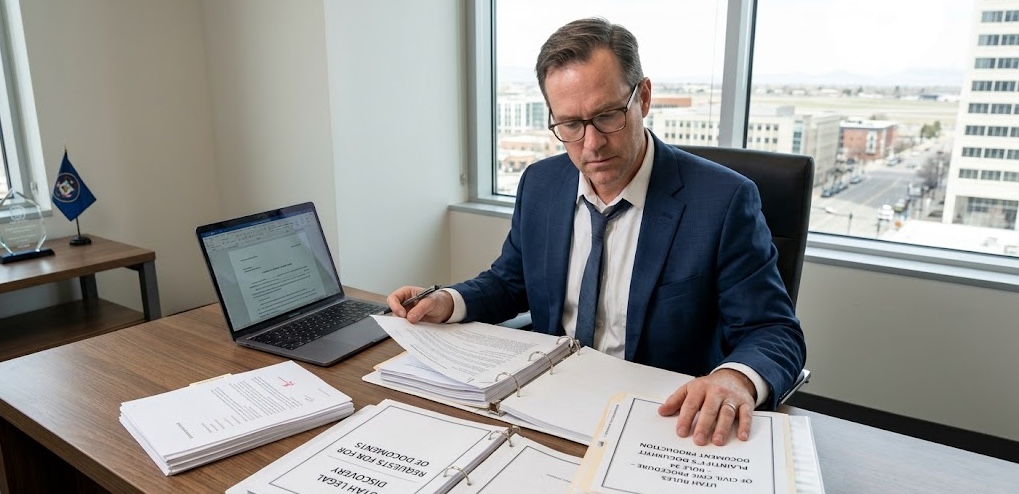
How to Request Documents in Utah Lawsuits
Why this matters: Knowing how to request documents in Utah lawsuits can shape the strength of your case, the quality of the evidence you gather, and your ability to respond to what the other side claims. In many civil disputes, document requests are one of the most practical tools available during discovery.
These requests are often used to obtain contracts, communications, photographs, business records, financial documents, insurance materials, repair records, medical records, and other items that may help prove or defend a claim. But the process is not just about asking for everything. Utah discovery rules require relevance, timing, and care in how requests are written and answered.
Note: This article is for educational purposes only and is not legal advice. How discovery works in a specific Utah case depends on the claims, defenses, court rules, deadlines, objections, and the facts involved. If you are involved in a Utah lawsuit, it is wise to get legal guidance before serving or responding to document requests.
How to Request Documents in Utah Lawsuits
If you are searching for Utah discovery, how to request documents in Utah lawsuits, or general guidance under Utah law, you are probably trying to understand how one side can formally ask the other side to produce records and materials that matter to the case. This is a core part of litigation and often a key turning point in settlement, motion practice, and trial preparation.
In Utah civil cases, requests for documents usually arise during discovery. Discovery is the stage where both sides exchange information that is relevant to the claims and defenses in the lawsuit. Document requests can help clarify disputed facts, test what the other side can actually prove, identify missing evidence, and build a stronger factual record.
Good discovery is not about flooding the other side with vague demands. It is about asking for targeted materials that relate to the legal issues in the case. When done well, document requests can narrow the dispute, improve negotiations, and help each side prepare for depositions, motions, and trial.
For broader background, see our Utah discovery, evidence and motions practice guide, Utah contract dispute litigation guide, and Utah trial preparation and appeals guide.
Overview of Document Requests in Utah Litigation
Requesting documents is part of the broader discovery process. In practical terms, one party serves a written request asking the other party to produce specific categories of documents or electronically stored information that are relevant to the case. The receiving party then responds by producing the documents, objecting, or stating that the requested materials are not in their possession, custody, or control.
Document requests can serve several purposes. They may help prove damages, confirm timelines, identify witnesses, challenge credibility, or show what a party knew and when they knew it. In business disputes, they may reveal contracts, invoices, internal communications, and accounting records. In personal injury matters, they may include medical bills, photos, insurance materials, and repair estimates.
They help clarify facts
Documents often reveal timelines, communications, and records that are more reliable than memory alone.
They shape case strategy
The records you obtain may affect settlement, motion practice, and preparation for depositions or trial.
They require precision
Overbroad or vague requests can lead to objections, delays, and disputes that weaken discovery.
They are governed by rules
Utah discovery practice involves deadlines, scope limits, and procedural requirements that matter.

Because discovery can influence the entire direction of a case, it helps to think strategically. The best document requests are usually those that are specific enough to be enforceable, broad enough to capture useful evidence, and clearly tied to the issues in dispute.
Key Definitions and Utah Discovery Concepts
Before serving a request, it helps to understand a few basic terms. A document request is often called a request for production. It asks the other side to produce documents, electronically stored information, or tangible items within the scope allowed by Utah discovery rules. The key question is usually whether the requested materials are relevant and within the responding party’s possession, custody, or control.
Another important point is that discovery is not unlimited. Utah law generally focuses on information tied to claims and defenses rather than fishing expeditions with no clear connection to the issues in the case. That means a request works best when it is linked to specific allegations, disputed facts, damages issues, or defenses already in play.
Request for production: A formal written discovery request asking for documents, electronically stored information, or tangible things.
Possession, custody, or control: Materials the responding party has, manages, or has the legal ability to obtain.
Relevant information: Materials tied to the claims, defenses, damages, timeline, or other disputed issues in the lawsuit.
Objection: A formal response explaining why a request is improper, overbroad, privileged, burdensome, or otherwise not subject to production.
In real cases, the value of a request often comes down to wording. A well-written request can uncover useful records. A poorly written one can invite objections and waste time.
Typical Court Procedure for Requesting Documents
Most Utah lawsuits follow a discovery process where each side exchanges information in stages. Document requests usually come after the case is filed and the parties have enough information to identify what records matter. In many cases, parties also start with initial disclosures, which may already require sharing certain information and documents early in the case.
After that, a party may serve targeted requests for production. The responding party then has to review the requests, gather responsive documents, evaluate objections, and provide a written response. If the response is incomplete or objections appear improper, the dispute may lead to further meet-and-confer efforts, motion practice, or a court order compelling production.
Identify what you need
Start with the issues in dispute and decide which records would help prove or disprove those points.
Draft clear requests
Ask for defined categories of documents using language that is specific, relevant, and tied to the case.
Serve the request properly
Make sure the request is served in the manner required for the case and within the discovery schedule.
Review the response
Check whether documents were produced, whether objections were made, and whether key materials appear to be missing.
Address disputes if needed
If production is incomplete, the next step may involve follow-up requests, negotiation, or a motion to compel.
Watch: Discovery Requests and What They Include
This video fits here because it gives a practical overview of how discovery requests work in litigation, including the role document requests can play in building a case.
What Documents Are Commonly Requested
The exact categories depend on the type of lawsuit. Still, many Utah cases involve a familiar set of materials. The point is not to request every paper a party has ever touched. The point is to identify the records that matter to the dispute.
| Case issue | Common document requests | Why they matter |
|---|---|---|
| Contract disputes | Signed contracts, amendments, invoices, payment records, emails, texts | They help establish terms, performance, breach, and damages |
| Personal injury claims | Medical records, billing statements, photographs, repair estimates, insurance materials | They can support causation, damages, and the timeline of the injury |
| Business disputes | Accounting records, internal communications, policies, bank records, reports | They may reveal financial impact, knowledge, and decision-making |
| Property disputes | Deeds, appraisals, inspection reports, maintenance records, correspondence | They can show ownership, condition, value, and notice of defects |
| General timeline disputes | Calendars, notes, text messages, emails, photos, logs | They often help reconstruct events more reliably than memory alone |
A good request usually connects the document category to a specific disputed issue. That makes the request easier to defend and often makes the response more useful.
Watch: Requests for Production of Documents and Tangible Things
This video belongs in this section because it focuses directly on requests for production and explains how document requests work as part of the litigation discovery process.
Required Forms Filings and Practical Drafting Issues
In many cases, document requests themselves are served on the opposing party rather than filed as standalone public court documents at the outset. Still, the overall discovery process may involve scheduling orders, disclosure requirements, certificates of service, and later motion papers if there is a dispute about production.
What matters most at the drafting stage is clarity. Requests should define key terms where needed, identify a reasonable time frame, and describe document categories in a way that is understandable and connected to the issues in the case. Overly broad language can make enforcement more difficult and may invite predictable objections.
Be specific about categories: Ask for identifiable groups of records instead of sweeping demands for all documents related to everything.
Use reasonable time limits: Requests tied to a meaningful date range are often stronger than open-ended demands.
Consider electronic records: Emails, texts, spreadsheets, and other digital files may be just as important as paper documents.
Prepare for objections: A request should be written in a way that helps show why the materials are relevant and proportional.
This reel fits here because it highlights early discovery obligations, including the exchange of important documents and witness information near the start of a case.
Common Objections and Discovery Disputes
Not every request results in full production. The responding party may object that a request is too broad, seeks privileged information, is unduly burdensome, or asks for materials that are not relevant to the claims and defenses. Some objections are valid. Others are used too aggressively and may need to be challenged.
That is why reviewing the response carefully matters. A response may appear complete at first glance but still leave out important categories of documents. In other situations, the objections may be so general that they do not meaningfully explain what is being withheld.
Overbreadth objections
These usually argue that the request is too sweeping or not reasonably limited to the issues in the case.
Privilege objections
Some communications or materials may be protected, but the claim of privilege should be evaluated carefully.
Burden objections
A party may argue that locating or producing the requested materials would be unduly difficult or expensive.
Relevance objections
These claim the requested materials do not relate closely enough to the issues actually being litigated.
Watch: Requests for Production and Examinations
This video fits naturally here because it explains the mechanics of document requests and gives context for how parties handle production and related discovery issues.
Common Mistakes to Avoid When Requesting Documents
Discovery problems often come from strategy mistakes rather than just legal mistakes. A party may ask for too much, too little, or the wrong things. They may use generic form requests without adapting them to the actual case. Or they may overlook how the other side is likely to object.
Avoid vague requests: Broad language can weaken the request and make compliance harder to enforce.
Avoid asking for everything: Focus on the records most likely to matter to liability, defenses, and damages.
Avoid ignoring electronic evidence: Emails, texts, metadata, and digital records are often central in modern cases.
Avoid missing deadlines: Discovery is often governed by schedules that can affect whether requests are timely.
This reel supports this section because it explains what discovery means in a lawsuit and reinforces that handing over relevant documents is a core part of the process.
What Happens If the Other Side Does Not Produce the Documents
If the other side fails to produce requested materials, responds evasively, or makes objections that seem unsupported, the issue may not end with the written response. Discovery disputes often require additional effort to narrow the disagreement and decide whether court intervention is necessary.
In many cases, the next step is to identify exactly what is missing and why it matters. That may lead to follow-up correspondence, a more focused request, or a motion asking the court to compel production. When discovery disputes escalate, motion practice can affect costs, deadlines, and leverage in the case.
This reel works well here because it emphasizes that discovery is where both sides are expected to produce the evidence and records behind their positions.
Next Steps for Using Document Requests Effectively
If you are preparing to request documents in a Utah lawsuit, the practical starting point is to identify what facts you need to prove, what defenses you expect, and what records are most likely to answer those questions. Discovery works best when it is tied to a clear case theory rather than used as a generic checklist.
Talk With Gibb Law About Utah Discovery Strategy
Gibb Law helps Utah clients navigate litigation with practical, clear, and evidence-focused guidance. If you need help with Utah discovery, drafting document requests, responding to production demands, or handling a discovery dispute in a lawsuit, our firm can help you evaluate the issues and take the next step with a stronger strategy.
Schedule a ConsultationLegally Reviewed by Dustin Gibb, Kaysville & Clearfield Lawyer
This article was legally reviewed by Dustin Gibb, a Utah attorney serving Kaysville, Clearfield, and surrounding communities. Dustin brings practical experience in Utah litigation and motion practice, including discovery disputes, evidentiary issues, and civil court procedure. If you need personalized legal guidance about requesting documents in a Utah lawsuit, contact Gibb Law to discuss your options and next steps.