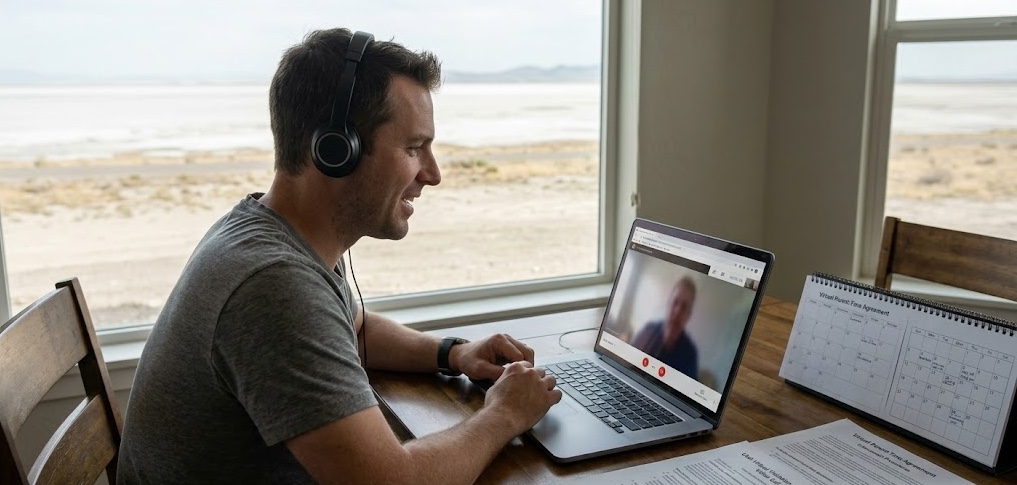
Virtual Visitation in Utah: Video Calls, Rules, and Enforcement
Why this matters: Parenting time used to mean one thing: in-person time under a court-ordered schedule. Today, many Utah families also rely on video calls, messaging, and other tools to keep a parent-child relationship alive between exchanges. When parents live far apart, travel for work, serve in the military, or deal with safety restrictions, virtual visitation can be the difference between “I saw you last month” and “I still feel like your parent this week.”
But virtual visits can also become a new battleground. One parent may control the device. Another may claim the calls are “too disruptive.” Kids may be pulled into adult conflict. And when there is no clear plan, even well-meaning parents can slide into missed calls, last-minute changes, and accusations of interference.
Note: This article is for educational purposes and is not legal advice. Utah custody outcomes depend on the facts, the evidence, and procedure. If you need advice for your situation, speak with a Utah family law attorney.
Virtual Visitation in Utah.
Parents search phrases like virtual visitation Utah and online parent time Utah because they want practical answers: Is a parent “allowed” to FaceTime? Can a judge require it? What happens if the other parent blocks calls?
In Utah family law, the term you will often see in statutes is virtual parent-time. It generally refers to parent-child contact using tools like telephone, email, instant messaging, and video conferencing. In real life, that means FaceTime, Zoom, Google Meet, WhatsApp video, or a child-friendly calling app, depending on what the parenting plan allows and what the parents can reasonably support.
Virtual contact is not a replacement for a normal parent-time schedule. Most families use it as a bridge: a way to maintain continuity between in-person periods, keep younger children connected to a parent’s daily life, and reduce the emotional “reset” that can happen after long gaps. When used well, virtual visitation supports stability. When used poorly, it can create more conflict.
If you want the broader framework for how parent-time schedules work in Utah, start with our Utah child custody and parenting time guide. If virtual visitation disputes are showing up during divorce, it also helps to understand timing, temporary orders, and how final decrees are entered in our Utah divorce process guide.
Big idea: Virtual visitation works best when it is specific. A clear plan about times, duration, platforms, and boundaries prevents many enforcement problems later.
What helps most: A child-focused routine, a realistic schedule, and written expectations about how parents will support calls without hovering or interfering.
What hurts most: Using video calls as a control tool, treating the child like a messenger, or turning “tech issues” into a pattern of blocked contact.
The video below provides a Utah-oriented overview of visitation rights, including how electronic or virtual contact can be addressed in custody and parent-time orders.
Watch: Utah Visitation Rights and Virtual Contact
How Utah Courts Approach Virtual Visitation
Utah courts decide custody and parent-time based on what supports a child’s best interests and day-to-day stability. Virtual contact fits into that same goal: keep parent-child relationships strong without harming routine, school, sleep, or emotional safety.
Utah law specifically recognizes that virtual contact can be part of “parent-time” and that parents should generally support reasonable communications between a child and the other parent. When the tools are reasonably available, Utah’s approach is often less about whether virtual contact is “allowed” and more about how to structure it so it stays predictable and child-focused.
In practice, court-ordered virtual visitation can show up in several common scenarios:
Distance parenting
When a parent lives far enough away that weekday contact is hard, a virtual routine can reduce long gaps between in-person visits.
Younger children who need continuity
Short, predictable calls can help younger kids stay attached to a parent between exchanges, especially when separation is new.
High-conflict co-parenting
A structured virtual clause can reduce ambiguity and limit “informal gatekeeping,” where one parent controls access through device or scheduling changes.
Safety or supervision concerns
In some cases, virtual supervised contact is used as a controlled option when the court believes unrestricted access could risk harm or instability.

When virtual visitation disputes become legal disputes, details matter. Missed calls, contested “tech failures,” privacy issues, and harassment allegations often become evidence questions. A plain-English overview of how evidence and motions work in Utah is our Utah discovery, evidence, and motions practice guide.
Key Utah Legal Standards and Statutes for Virtual Parent Time
You do not need to be a lawyer to understand the backbone of virtual visitation in Utah. But you do need to know the key concepts courts return to again and again: reasonable communication, child-focused boundaries, and a schedule that supports stability.
Virtual parent-time is a recognized concept
Utah’s domestic relations code defines virtual parent-time as parent-time facilitated through tools like telephone, email, instant messaging, video conferencing, and other wired or wireless technology. In everyday terms, Utah law recognizes that meaningful parent-child contact can happen through modern communication methods, not only in person.
Phone calls and virtual contact are treated as “reasonable” when structured well
Utah’s minimum parent-time schedules include a straightforward baseline idea: telephone contact should be at reasonable hours and for a reasonable duration. The schedules also address virtual parent-time when parents are far apart, and they emphasize that virtual contact supplements in-person time rather than replacing it.
Distance matters: Utah’s minimum schedule language specifically references virtual parent-time when the parents live at least 100 miles apart and the equipment is reasonably available.
Costs matter: If parents disagree about whether equipment is reasonably available, the court can consider best interests, expense, and other material factors.
It is a supplement: Virtual parent-time is intended to support a relationship between visits, not to replace in-person parent-time.
Parents are generally expected to support communication
Utah’s custody and parent-time guidelines emphasize cooperation. That includes sharing contact information and allowing reasonable, child-focused communication. When virtual visitation is in dispute, a judge often looks for the same thing the judge looks for in other parent-time issues: Is a parent acting reasonably and putting the child first?
If your virtual visitation issue is part of a broader custody conflict, the bigger roadmap matters. Start with our Utah child custody and parenting time guide, then review negotiation and timelines in our Utah divorce process guide.
If safety concerns overlap with virtual contact, the legal path can change fast. For a plain-English overview of protective orders and related custody issues, see our Utah domestic violence and protective orders guide.
Utah Custody Technology in Practice: What a Strong Virtual Visitation Plan Looks Like
Most virtual visitation conflicts are not about the idea of video calls. They are about the lack of a plan. A strong clause answers the questions parents fight about later, when emotions are high and trust is low.
Below is a practical structure many families use to reduce conflict and make Utah custody technology work as intended: as a stable routine that supports the child.
Set a predictable schedule
Pick specific days and windows (for example, two evenings per week) that work with school, dinner, and bedtime. Predictability is often more important than frequency.
Define the platform and backup option
Name the primary method (FaceTime, Zoom, or another app) and a backup method if the first fails. This reduces “tech excuses” and last-minute conflict.
Clarify who provides the device and internet access
If a child is too young to manage a device independently, the plan should define the adult’s role: helping the child connect without hovering or interfering.
Set privacy and boundaries
Children should not be pressured to report on the other parent’s home. Calls should not become adult interrogation sessions. Clear boundaries reduce conflict and protect the child.
This Instagram reel discusses how Utah law has evolved to recognize the importance of both parents being actively involved in a child’s life. That same principle often drives courts to support reasonable parent-child communication, including virtual visitation when appropriate.
When parents are able, it also helps to include a dispute-resolution step for future disagreements. Utah courts often encourage parties to use mediation or other dispute-resolution methods rather than rushing back to court for every schedule conflict. Our Utah mediation and arbitration guide explains how these processes can reduce cost and conflict in family law disputes.
How Judges Evaluate Evidence in Virtual Visitation Disputes
Virtual visitation disputes often feel personal, but judges need proof. The court typically looks for: what the order says, what actually happened, and whether a parent’s conduct was reasonable and child-focused.
In a virtual visitation conflict, evidence usually falls into a few predictable categories:
The written order and parenting plan
If the plan is vague, enforcement becomes harder. If the plan is specific, the court can compare conduct to clear requirements.
Communication history
Texts and emails that show reasonable requests, consistent scheduling, and calm problem-solving often matter more than emotional allegations.
Call logs and patterns
Dates, times, missed connections, and repeated “tech problems” can help show whether a problem is occasional or a pattern.
Child-focused impact
Judges often focus on whether the child’s routine is respected and whether the calls support a healthy relationship without pressure or conflict.
The table below summarizes what courts are often trying to decide in a virtual visitation dispute, what may help prove it, and what commonly hurts credibility.
| What the court is trying to decide | Examples of evidence that may help | Common credibility problem |
|---|---|---|
| Is the schedule clear and reasonable? | Parenting plan language, consistent proposed times, school and bedtime context, a realistic duration for the child’s age | Asking for constant calls without regard to routine, then calling it “denial” when the other parent says no |
| Is there a pattern of interference? | Call logs, repeated missed connections, written messages offering reasonable alternatives, documentation of device unavailability | Relying on a few isolated incidents without showing repetition or willfulness |
| Are “tech problems” genuine or a pretext? | Proof of troubleshooting, backup methods, consistent access when the same tech is used for other purposes | Vague claims like “the internet was down” with no effort to reschedule or use a backup method |
| Is the communication child-focused? | Call content staying age-appropriate, no harassment, no interrogation about the other home, no adult conflict on speakerphone | Using calls to argue with the other parent or pressure the child to pick sides |
| What remedy actually helps the child? | A specific fix: defined windows, neutral exchange procedures, make-up calls, clear boundaries, or supervised options when needed | Only asking the court to “punish” the other parent instead of proposing a workable plan |
Courts reward specificity: Clear schedules and documented patterns are easier to enforce than vague expectations.
Courts reward stability: Child routine matters. A plan that respects school, sleep, and emotional regulation often looks more credible.
Courts reward child-focused solutions: The best request is usually the one that fixes the problem without escalating conflict.
If your case may involve hearings, exhibits, subpoenas, or contested digital records, our Utah discovery, evidence, and motions practice guide can help you understand what matters and why.
Virtual Supervised Visitation: When Video Calls Are Used With Safety Concerns
Some families use virtual visitation not only for convenience, but as a safer structure when in-person contact is restricted. In Utah, courts can order supervised parent-time when the court finds evidence that unsupervised contact could expose a child to harm and there is no less restrictive option reasonably available.
Virtual supervised visitation can take different forms, depending on what the order requires. In some cases, a neutral third party or professional agency supervises the interaction. In other cases, the supervision is tied to a specific safety concern, and the order is designed as a step toward greater contact if the parent demonstrates stability and compliance.
The video below explains how virtual supervised visitation works and why video calls are sometimes used as part of supervised contact between a parent and child.
Watch: Virtual Supervised Visitation
This Instagram post emphasizes a custody reality that often shows up in virtual visitation disputes: Utah courts prioritize stability and the child’s well-being. Virtual contact may be supported when it promotes stability, but restricted when it increases conflict or harms routine.
If virtual contact is being limited because of domestic violence, harassment, or safety concerns, it is important to understand how protective orders can affect communication rules. See our Utah domestic violence and protective orders guide for a plain-English overview of safety-related custody and parent-time issues.
Online Parent Time and Technology Issues: What to Plan For
When parents fight about virtual visitation, the conflict is often framed as “rights,” but the real issue is usually logistics. A court can order virtual parent-time, but it cannot magically create reliable internet service, a quiet room, or a five-year-old’s attention span.
That is why a strong virtual visitation plan addresses the practical issues upfront:
Child age and duration: Younger children usually do better with shorter, more frequent contact. Older kids may prefer fewer calls with more autonomy.
Time zone and school schedule: A “reasonable hour” is often tied to bedtime, homework, and extracurricular routines.
Privacy and boundaries: Calls should not be used to spy on the other parent’s home or pull the child into adult disputes.
Backup method: A backup method (phone call if video fails) prevents a simple glitch from becoming an enforcement issue.
Virtual visitation technology also comes up in institutional settings, such as when a parent is in a correctional facility and contact occurs through a structured video visitation system. The video below describes technology used in institutional video visitation systems. The legal takeaway for many families is simple: when access is limited by the institution’s rules, your parenting plan should be realistic and specific about what is possible.
Watch: Virtual Visitation Technology in Institutional Settings
This Instagram post shares legal custody and visitation strategy context that can be helpful when planning how virtual contact should fit into a broader parenting plan.
If your situation involves long-distance parenting, schedule changes, or repeated conflict over communication, mediation can sometimes resolve issues faster than repeated court motions. Our Utah mediation and arbitration guide explains how Utah dispute-resolution tools can help parents build a workable plan.
Common Pitfalls to Avoid With Virtual Visitation
Virtual visitation can be a powerful tool, but it can also backfire when it is used in ways that increase conflict or pull the child into adult issues. These are some of the most common mistakes Utah families make.
Pitfall 1 Treating video calls like a weapon
If a parent uses calls to harass the other parent, monitor the other home, or pressure the child for information, courts may respond by narrowing or structuring communication to protect the child.
Pitfall 2 Keeping the schedule vague
“Reasonable calls” without a plan often turns into “we disagree about what reasonable means.” If your family has conflict, clarity is usually your friend: days, windows, duration, and a backup method.
Pitfall 3 Turning every glitch into a crisis
Technology fails. Batteries die. Internet drops. Courts are usually more concerned with patterns than with one bad night. What matters is whether the parent who had the child made a reasonable effort to help the child connect and reschedule when needed.
Pitfall 4 Making the child responsible for adult communication
Kids should not have to negotiate call schedules, defend a parent, or carry adult messages. If a child is too young to manage a device independently, the order should clarify the adult’s role in facilitating contact.
Keep it child-centered: Calls are for relationship building, not adult conflict.
Build a routine: Predictability often prevents enforcement fights.
Document patterns: Judges typically respond to repeated interference, not one-off frustration.
Enforcement in Utah: What to Do If Virtual Visits Are Blocked
Parents often ask the same question: “If the other parent blocks FaceTime, what can I do?” The answer depends on what your order says and how the conduct shows up in evidence.
In many cases, the best approach is to move step-by-step, keeping your conduct calm and reasonable. Courts tend to respond better to parents who show they tried to solve the problem before escalating it.
Check the exact language of your order
Enforcement starts with the text. If the order is vague, you may need clarification or a modification. If it is specific, you can point to missed requirements.
Make a clear written request
Use calm, child-focused language. Offer a specific time and a backup method. Written communication often becomes the record later.
Document patterns, not just frustration
Track dates, times, and outcomes. If calls are repeatedly missed, record what happened and how you tried to reschedule.
Use the court process when necessary
When a parent willfully fails to comply with an order, the other parent can ask the court to enforce it through a Motion to Enforce Order and request appropriate sanctions or remedies.
Utah courts provide a formal process to enforce existing orders through a Motion to Enforce Order (historically called an Order to Show Cause). In serious situations, courts can impose penalties and require compliance. If your dispute involves parent-time denial and you are not sure what forms or steps apply, procedure matters. You can also review our Utah discovery, evidence, and motions practice guide for a plain-English overview of how enforcement disputes are presented.
Practical reminder: Do not “self-enforce” by withholding the child, blocking the other parent’s communication, or changing the schedule unilaterally. Those choices can backfire and complicate your case.
Focus on remedies: Courts often prefer fixes that restore parent-child contact (make-up time, clear schedules, boundaries) over escalating conflict.
If a pattern of interference is proven, possible outcomes can include make-up parent-time and other court-ordered remedies. In more serious cases, repeated denial of contact can become part of a broader request to modify custody or parent-time if the existing arrangement is not working in the child’s best interests.
Next Steps for Virtual Visitation in Utah
If you are dealing with virtual visitation conflict, the most useful next step is to move from vague expectations to a plan that can be followed and enforced: specific times, clear tech rules, and child-focused boundaries.
Talk With Gibb Law About Virtual Visitation and Enforcement
Gibb Law helps Utah families build practical parenting plans and resolve parent-time disputes where clarity, evidence, and child stability matter. If virtual visitation issues are affecting your custody case, we can help you understand your options and next steps under Utah procedure.
Schedule a ConsultationLegally Reviewed by Dustin Gibb, Kaysville & Clearfield Lawyer
This article was legally reviewed by Dustin Gibb, a Utah attorney serving Kaysville, Clearfield, and surrounding communities. Dustin brings practical experience in Utah litigation and motion practice, and he helps clients navigate family law disputes where procedure, evidence, and enforceable parenting plans shape outcomes. If you need guidance specific to your situation, contact Gibb Law to discuss your options and next steps.